
Infrared Soap Dispenser Sensor Guide for Commercial Restrooms
Soap Dispenser Infrared Sensor Technology: How IR Dispensing Works
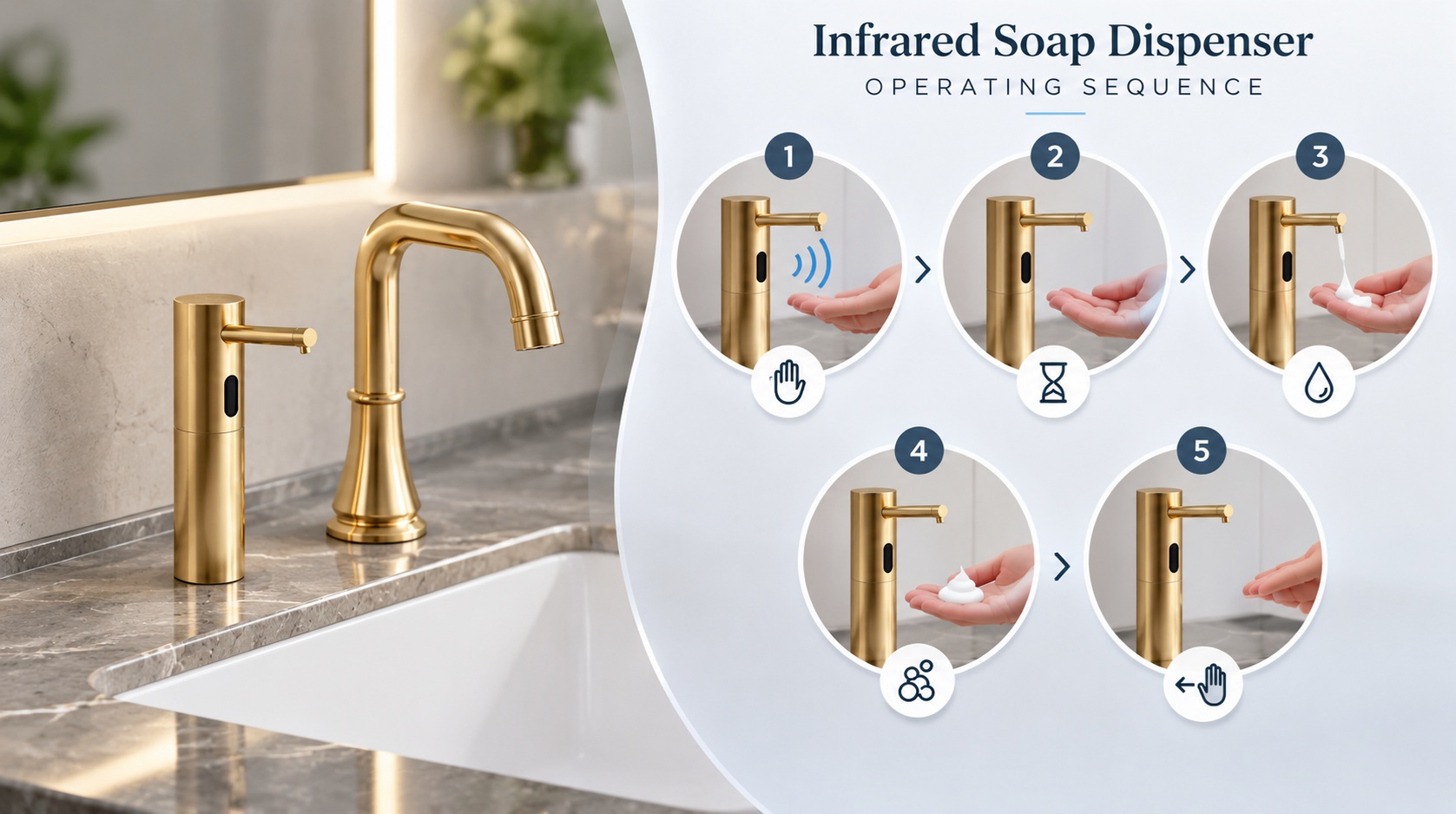
Soap dispenser infrared sensor systems use an IR emitter and receiver to detect a user’s hand and automatically trigger a preset soap-dispensing cycle without physical contact. In commercial restrooms, infrared sensing supports touch-free operation, consistent dosing, and predictable servicing. Performance depends on the detection zone, surrounding reflective surfaces, ambient lighting, sensor-window cleanliness, soap compatibility, and available power.
This guide explains how infrared soap dispensers work, why false activations occur, how IR compares with Time-of-Flight and capacitive sensing, and what architects, engineers, and facility teams should verify when specifying commercial sensor dispensers.
How an Infrared Sensor Soap Dispenser Works
Infrared Soap Dispenser Performance Matrix
IR performance depends on much more than whether a sensor detects a hand. Detection stability, lighting, surfaces, soap chemistry and power should be evaluated together.
| Engineering Factor | What It Controls | Possible Problem | Specifier Check |
|---|---|---|---|
| IR Detection Zone | Where the user’s hand triggers dispensing | Missed or premature activation | Verify natural one-hand activation position |
| Reflective Surfaces | Amount of IR energy returning to the receiver | Nuisance activation | Test with actual basin and backsplash finishes |
| Ambient Light | Sensor signal stability | Reduced detection consistency | Commission under real lighting conditions |
| Detection Threshold | Sensitivity to reflected IR | False triggers or missed hand detection | Verify tuning or model-specific sensor behavior |
| Lockout Timing | Repeated activation during one hand event | Double dosing | Confirm anti-repeat behavior |
| Soap Viscosity | Pump output and dose consistency | Weak dose, drip or pump stress | Use approved soap viscosity range |
| Battery Voltage | Sensor and pump performance | Slow response or inconsistent dosing | Evaluate performance through battery-life range |
| Sensor Window | IR transmission and reception | Residue-related missed triggers | Keep lens clean and unobstructed |
Infrared vs ToF vs Capacitive Soap Dispenser Sensors
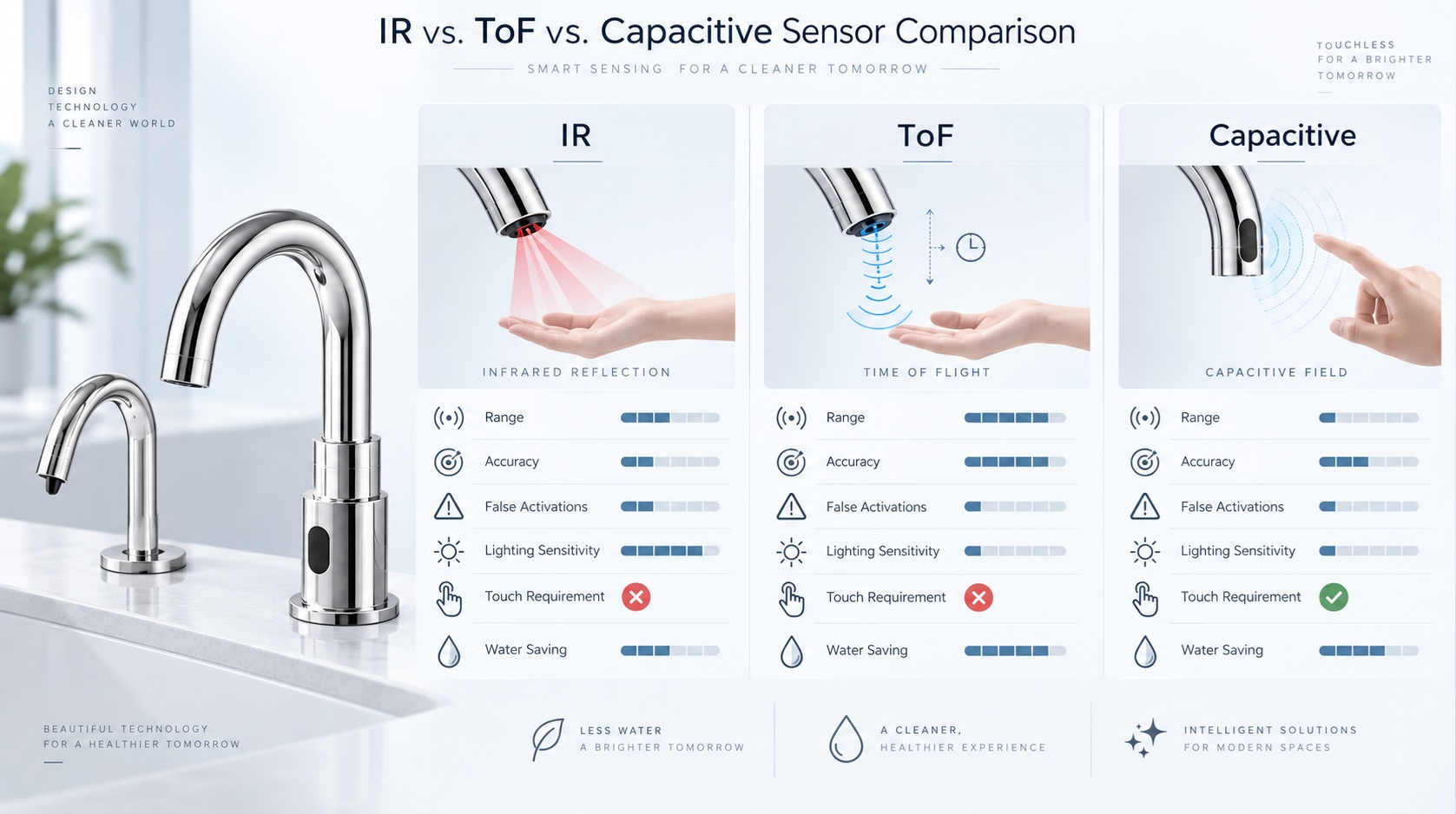
Uses emitted and reflected infrared energy to detect hand presence. It is widely used and cost-effective, but reflective materials, lighting and sensor-window contamination can affect performance.
Measures the travel time of emitted light to determine distance. This can provide more controlled distance measurement where precise activation zones are required.
Detects changes in an electrical field rather than reflected light. Its suitability depends on dispenser geometry, materials and the intended activation method.
Why Infrared Soap Dispensers False Trigger
Highly reflective surfaces can return IR energy differently than expected and may destabilize the detection zone.
High ambient infrared exposure can interfere with poorly controlled sensor systems.
An overly broad detection zone may react to users moving near the dispenser rather than intentionally reaching for soap.
Soap residue, water spots and cleaning chemicals can reduce the sensor’s ability to transmit or receive IR energy.
Reduced voltage may affect sensor processing, pump response or overall dispensing consistency.
Poor alignment can move the detection zone away from the user’s natural hand position.
Infrared Soap Dispenser Specification Checklist
Common Infrared Sensor Questions
How does an infrared soap dispenser detect your hand?
Most active infrared dispensers emit IR energy and monitor the reflected signal. When a hand enters the detection zone and the return signal meets the programmed threshold, the controller activates the pump.
Why does an infrared soap dispenser activate by itself?
Possible causes include reflective countertops, strong ambient light, an overly broad detection zone, nearby movement, sensor-window contamination or incorrect sensor positioning.
Are infrared soap dispensers good for commercial restrooms?
They can be highly effective when properly specified and commissioned. Commercial installations should prioritize stable sensing, metered dosing, soap compatibility, accessible servicing and resistance to false activation.
What is the difference between infrared and ToF sensing?
Traditional active infrared sensing generally evaluates reflected IR intensity or presence, while Time-of-Flight systems determine distance by measuring how long emitted light takes to return.
Can reflective sinks interfere with infrared soap dispensers?
Yes. Highly reflective basins, counters or backsplashes can alter how infrared energy returns to the receiver. Testing the dispenser with actual project finishes is advisable.
Infrared Sensor Dispensers
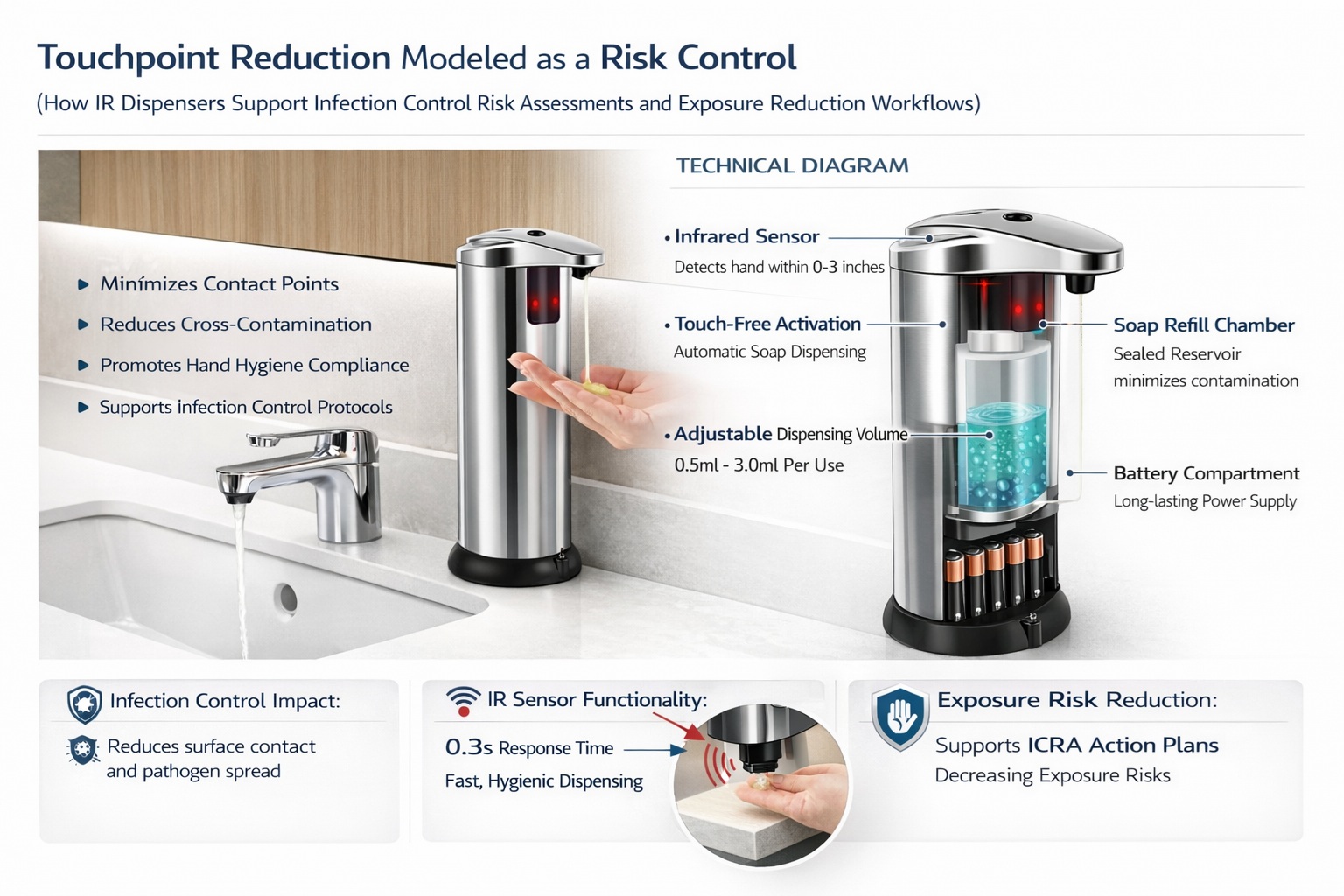
Reduce touchpoints and support infection control plans by standardizing hand hygiene at fixtures. Consistent metered dosing lowers soap waste, simplifies O and M forecasting, and improves restroom throughput in peak occupancy periods while aligning with facility risk mitigation protocols for modern spaces.
Infrared sensor dispensers are widely used in commercial restroom programs where predictable maintenance and high-traffic performance matter. This page covers how they work, what to specify, and real-world performance criteria that impact hygiene outcomes and maintenance outcomes.
Why infrared sensor dispensers are being standardized in commercial restrooms
Reduced contact at high-touch hygiene points
The dispenser is one of the most frequently used hygiene touchpoints in restrooms. Replacing manual actuation with infrared activation reduces hand contact at that location, which supports facility infection control planning and surface cleaning strategies.
Metered dosing reduces waste and stabilizes usage forecasting
Infrared models can be designed for metered output. Instead of variable user-controlled pumping, the dispenser runs a timed dose. This improves soap usage predictability, refill forecasting, housekeeping planning, and waste reduction.
Restroom throughput improves during peak occupancy conditions
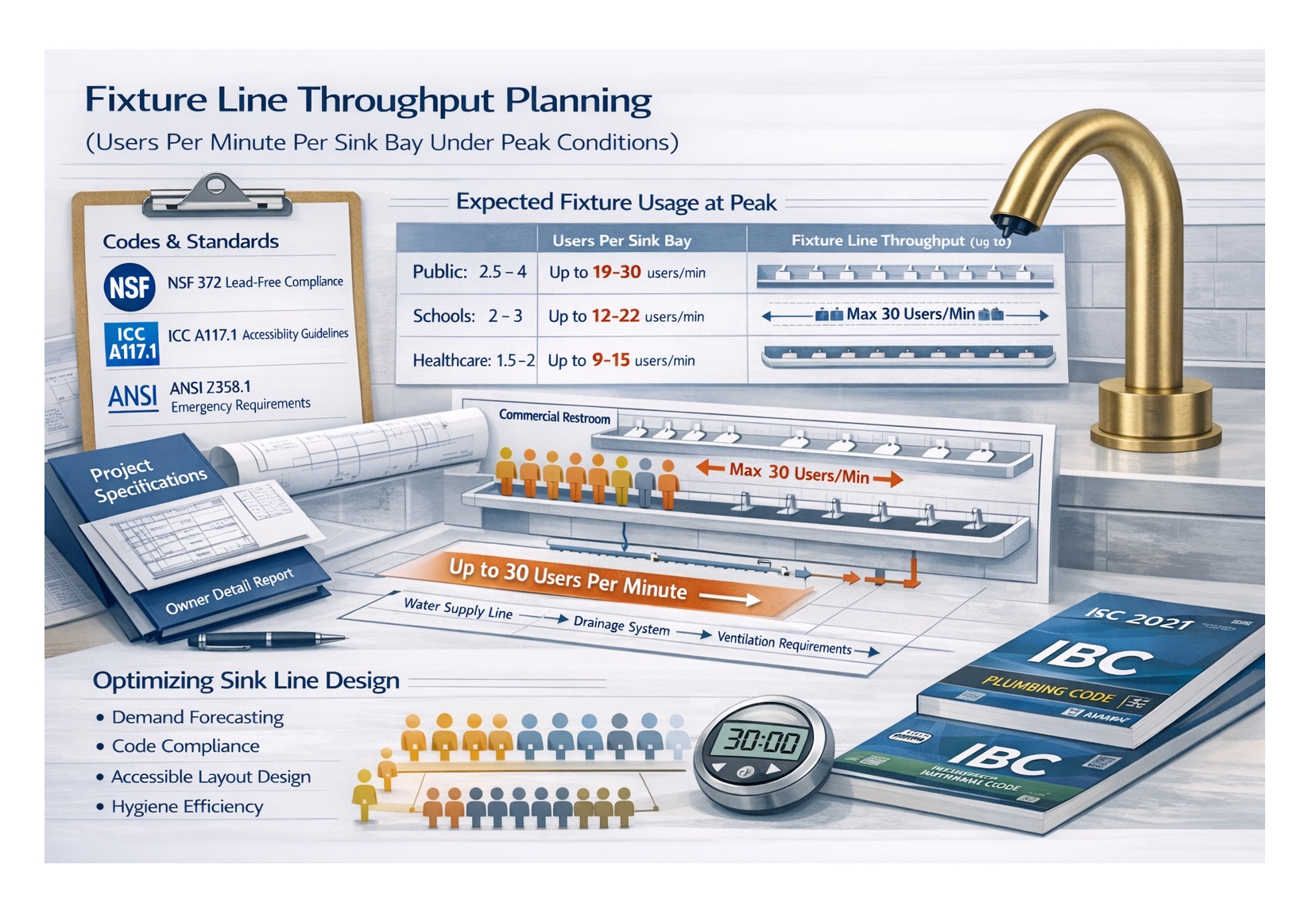
For high-traffic facilities like airports, schools, stadiums, and convention centers, throughput is a major design constraint. Touchless dispensing reduces friction in the wash sequence and keeps user movement more continuous, especially when paired with sensor faucets and touchless drying.
Operating Principle of Infrared Sensor Dispensers
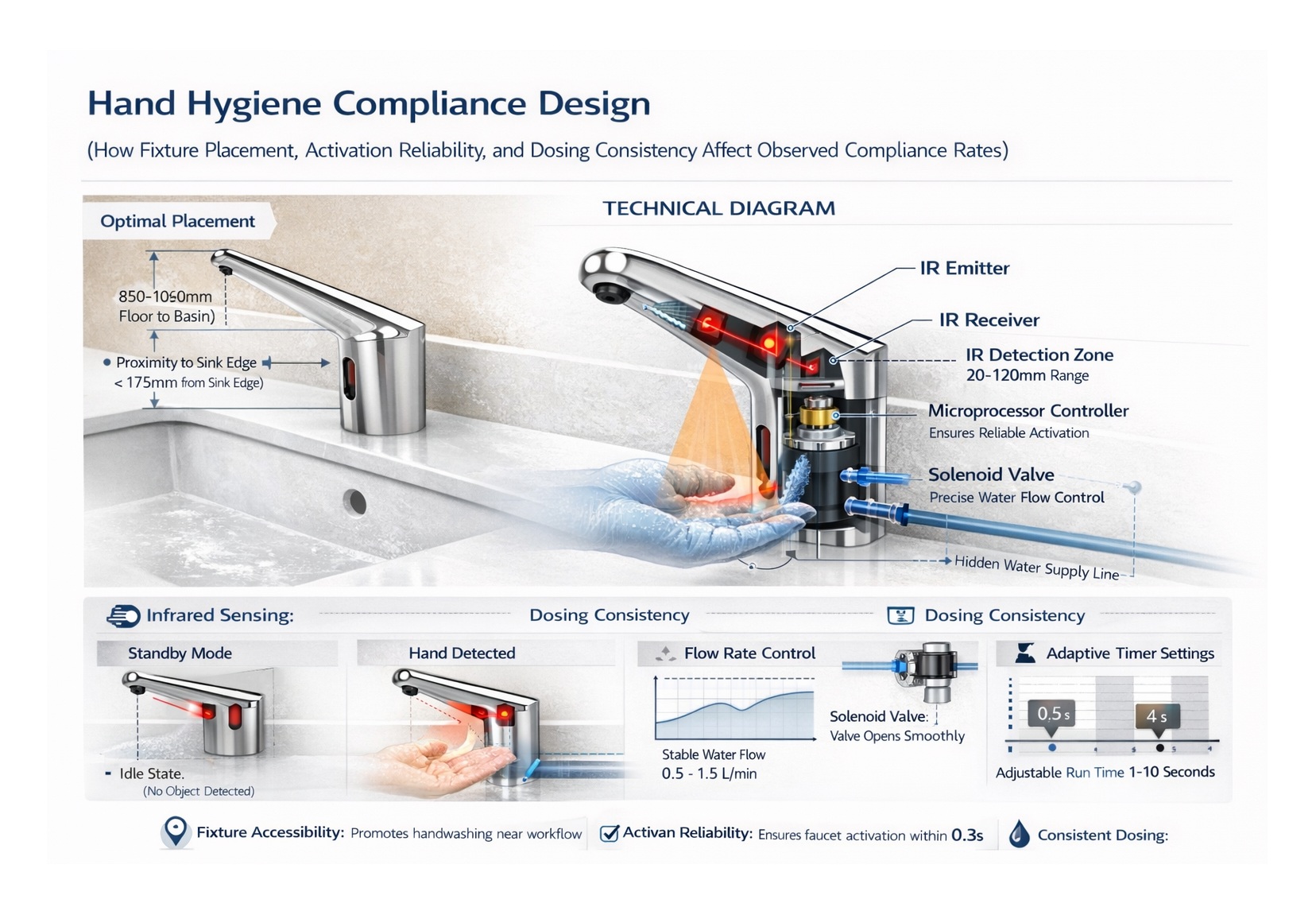
Most commercial infrared dispensers use active infrared proximity sensing by combining an IR emitter, an IR receiver, and firmware logic that interprets reflected IR energy. When a hand enters the detection zone, reflected IR is detected and the controller initiates a pump cycle for a predetermined dose.
Core system elements
- Sensor assembly: near-infrared emitter and receiver, protective lens, and detection filtering logic
- Controller: trigger threshold logic, cycle timing, lockout delay, and power management
- Pump system: diaphragm, peristaltic, or gear pumps depending on viscosity and drip control needs
- Fluid path: bulk reservoir dispensing or sealed cartridge refills
Field Performance Constraints in Real-World Deployments
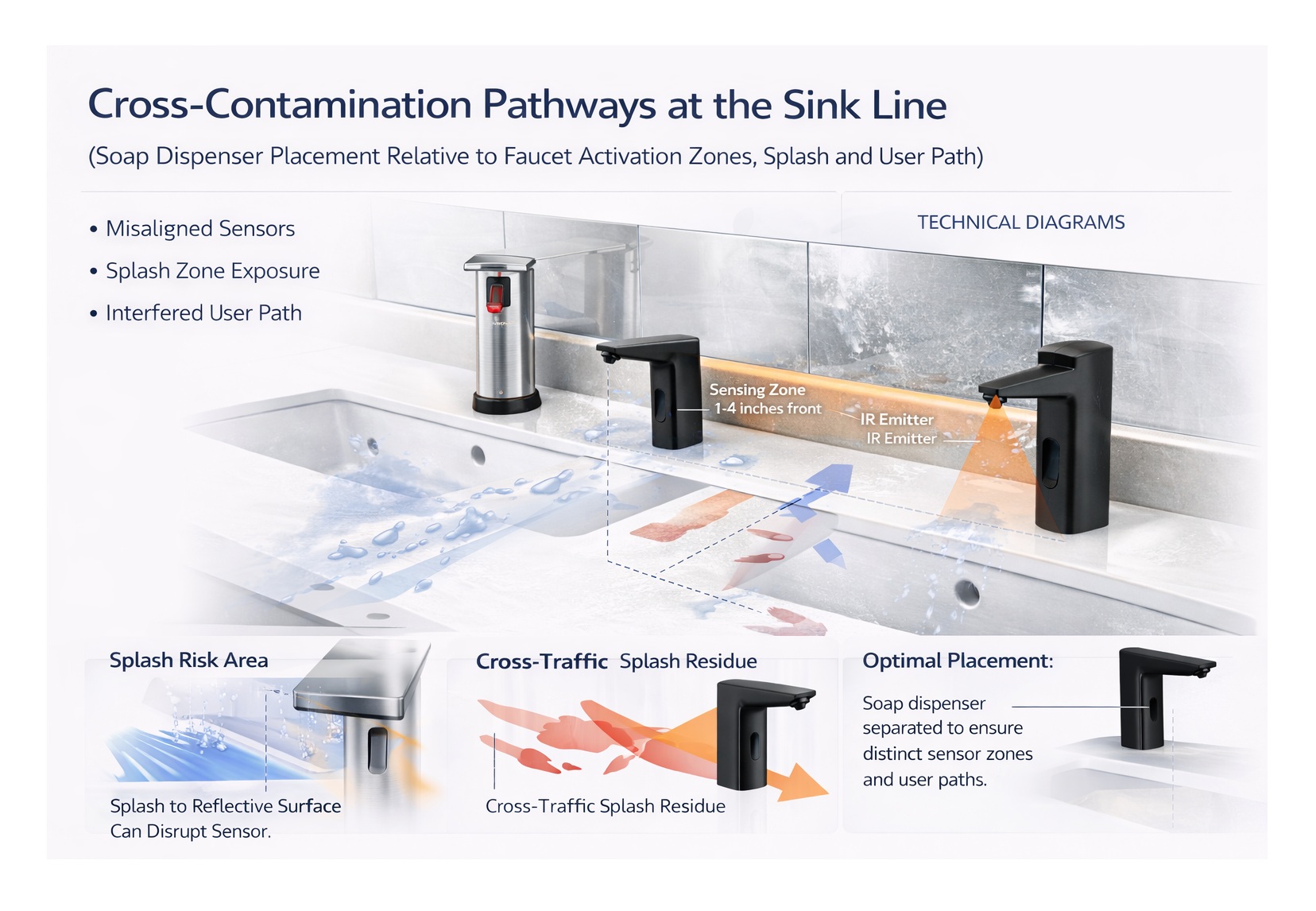
False triggers and nuisance activation
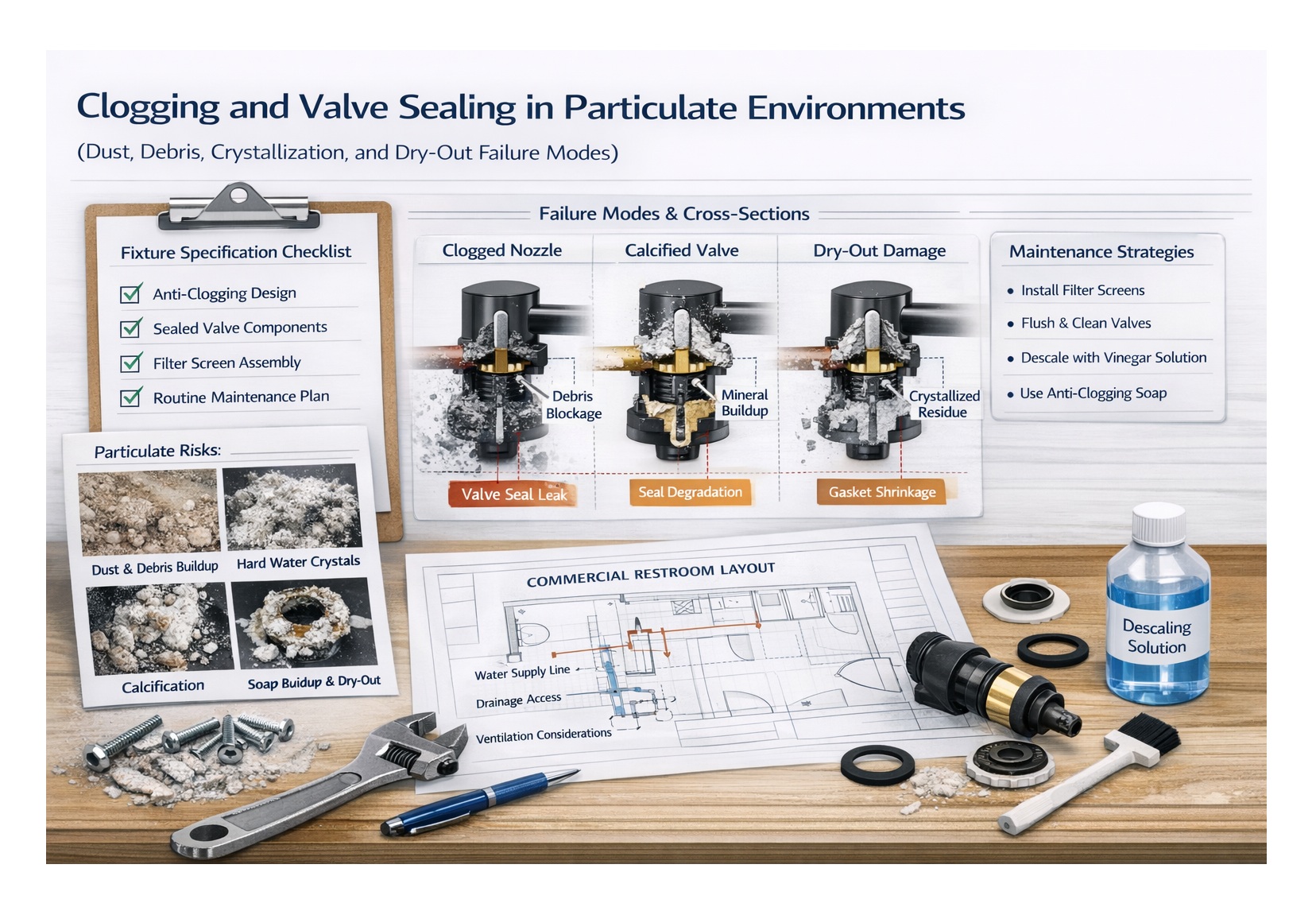
False triggers cause soap waste, countertop mess, increased housekeeping labor, and user frustration. They often occur due to reflective surfaces, strong sunlight, high movement zones near the sensor, or splashing that interferes with the sensor window.
Missed triggers and slow activation
Missed triggers are commonly tied to short detection zones, poor sensor aim alignment, soap residue on the sensor window, or low battery power. Inconsistent activation can cause users to skip soap entirely.
Fluid compatibility problems
Not every soap is compatible with every pump system. Viscosity and refill format can affect dosing stability. In the field, inconsistent dosing is often tied to using an incompatible soap type or inconsistent refill product.
AEC Specification Criteria
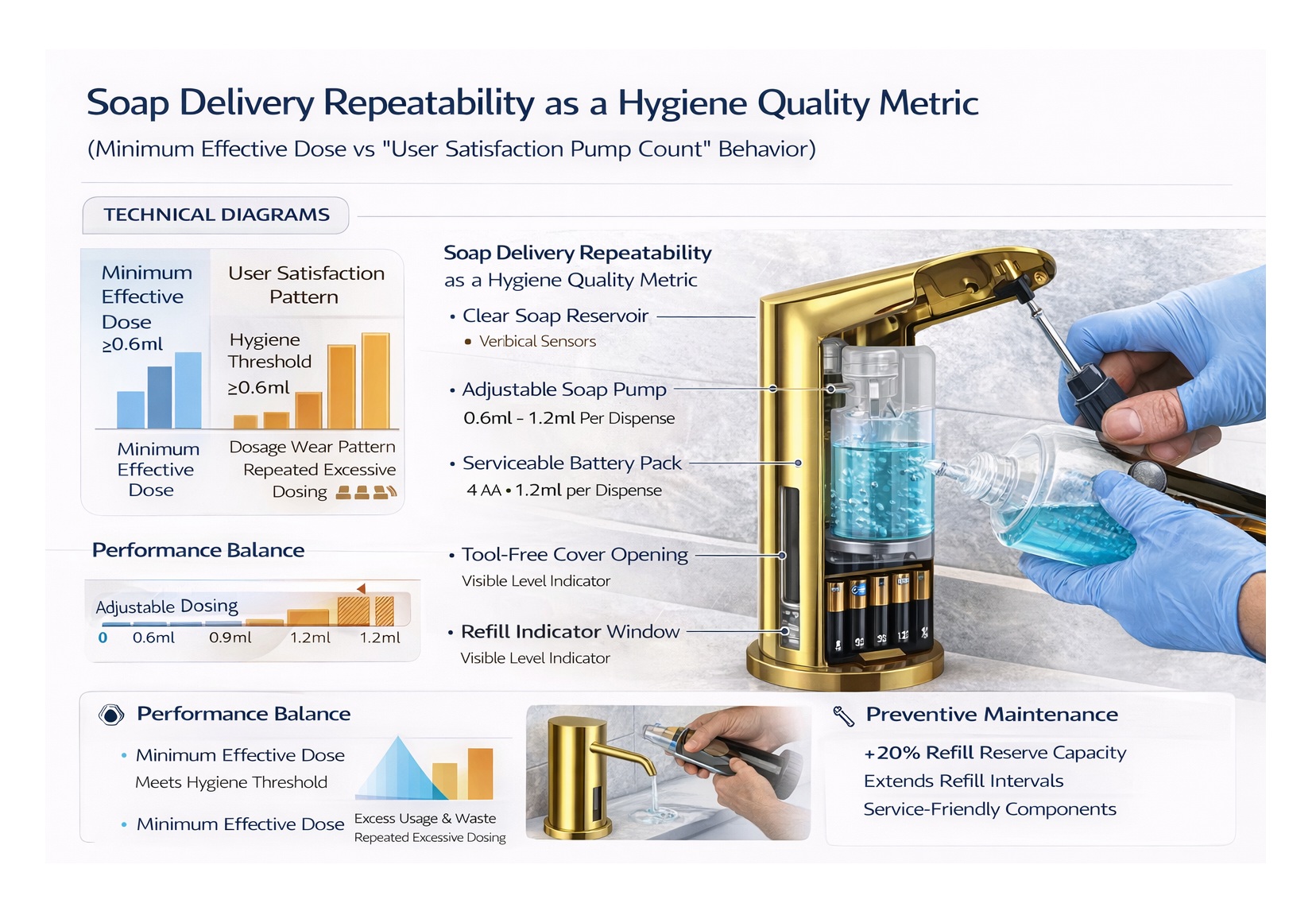
Metered dosing consistency
- Consistent dispensing volume per activation
- Stable output across battery life range
- Minimal drip after actuation
Detection zone control
- Stable detection distance for one-handed activation
- Limited sensitivity to pass-by movement
- Anti-repeat lockout to prevent multiple dispenses per hand entry
Refill strategy aligned with facility policy
Bulk refill systems can reduce unit cost but require disciplined refill and cleaning processes. Sealed cartridge systems can support hygiene control and standardized servicing with lower tamper risk.
Power strategy
Battery supports retrofit and avoids electrical scope. Adapter or hardwired reduces labor and waste from battery replacement in large portfolios.
Durability and vandal resistance
- Robust housing and tamper-resistant access
- Protected sensor window
- Service access suitable for high-traffic custodial operations
- Refill visibility via window or indicator
Installation planning and coordination notes
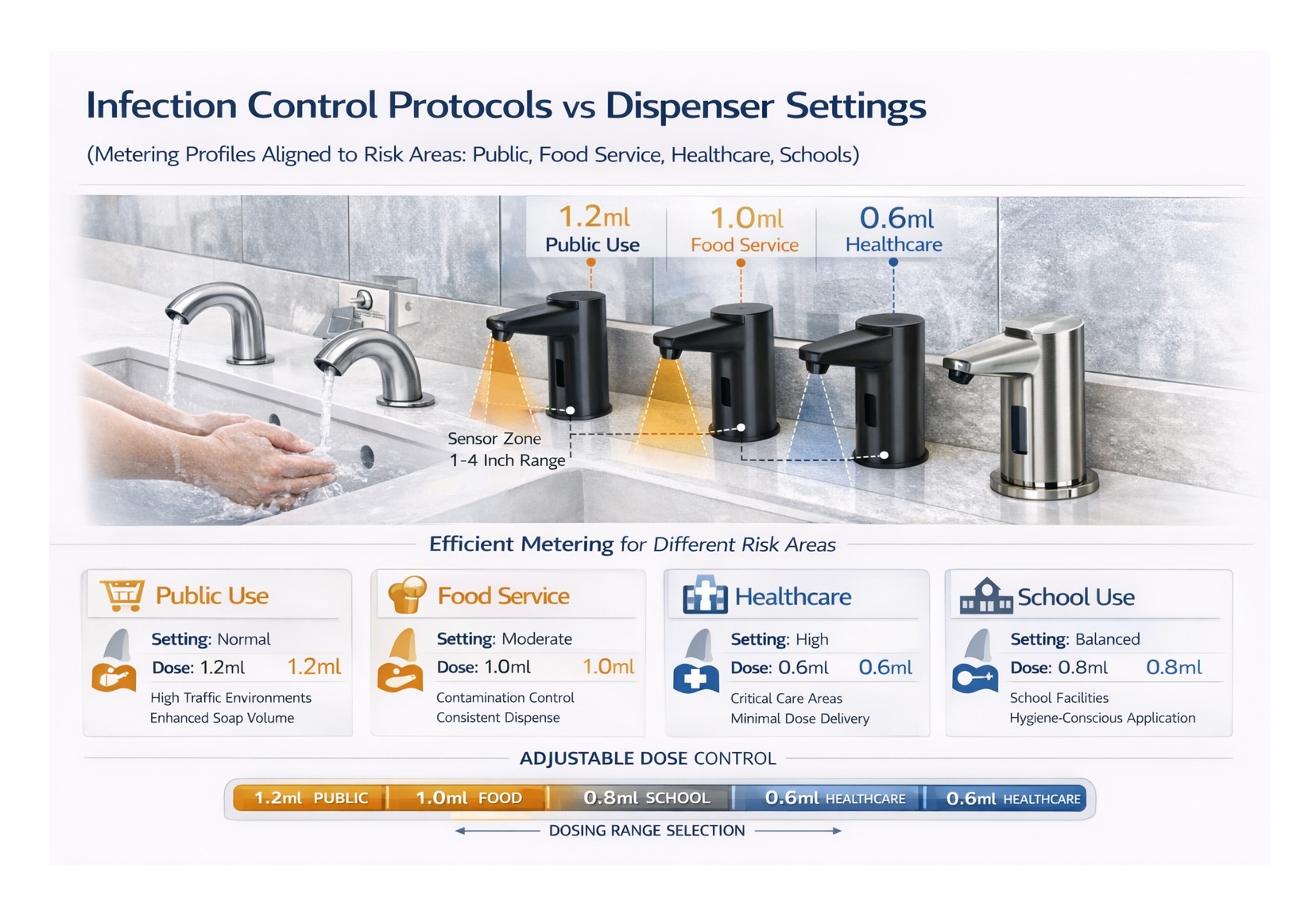
Placement and user flow
- Users can soap without turning away from the basin
- Activation zone is not exposed to heavy pass-by movement
- Dispenser placement supports wet hands → dispense soap → scrub → rinse
Countertop and backsplash interactions
Reflective finishes can increase nuisance triggers. If the project uses glossy materials, prioritize dispensers with adjustable sensing behavior or stable tuned detection.
Commissioning checks
- Test 10 to 20 consecutive dispenses for consistency
- Verify activation under real lighting conditions
- Observe drip behavior and residue patterns
- Confirm lockout behavior to prevent double-dosing
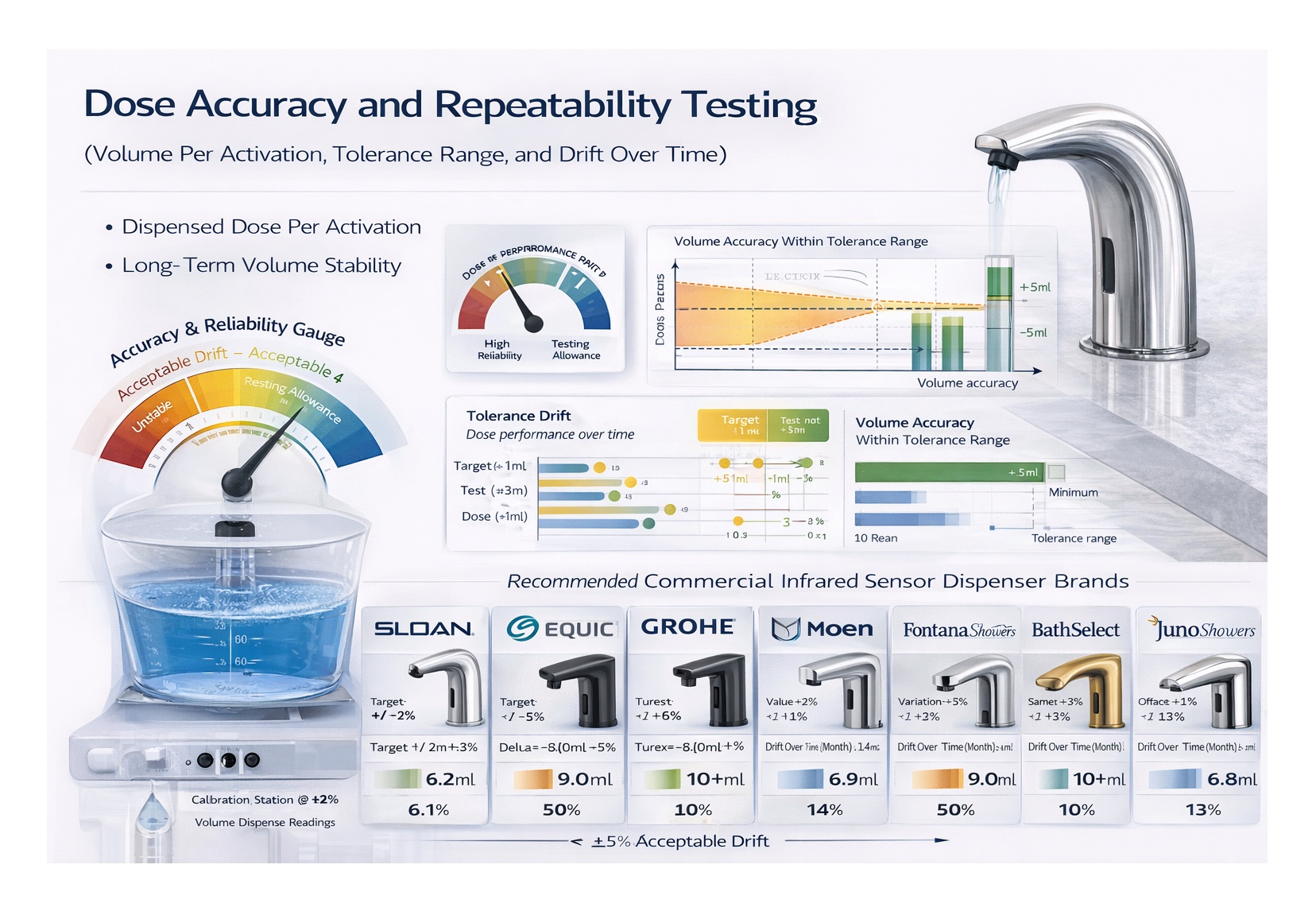
Recommended commercial infrared sensor dispenser brands
Specification checklist
Infrared sensor soap dispenser shall provide:
- Touchless activation using active IR proximity sensing
- Stable detection with minimal false triggering in reflective environments
- Metered dosing with consistent volume and anti-drip performance
- Lockout delay to prevent repeated dosing during a single hand presence event
- Soap compatibility appropriate for the facility product standard (foam or liquid)
- Refill strategy suitable for the facility risk mitigation plan (bulk or sealed)
- Power strategy aligned with maintenance resources (battery or adapter or hardwired)
- Durability and tamper resistance appropriate for occupancy type
- Service access suitable for high-traffic custodial operations
Why this matters in modern facility risk mitigation plans
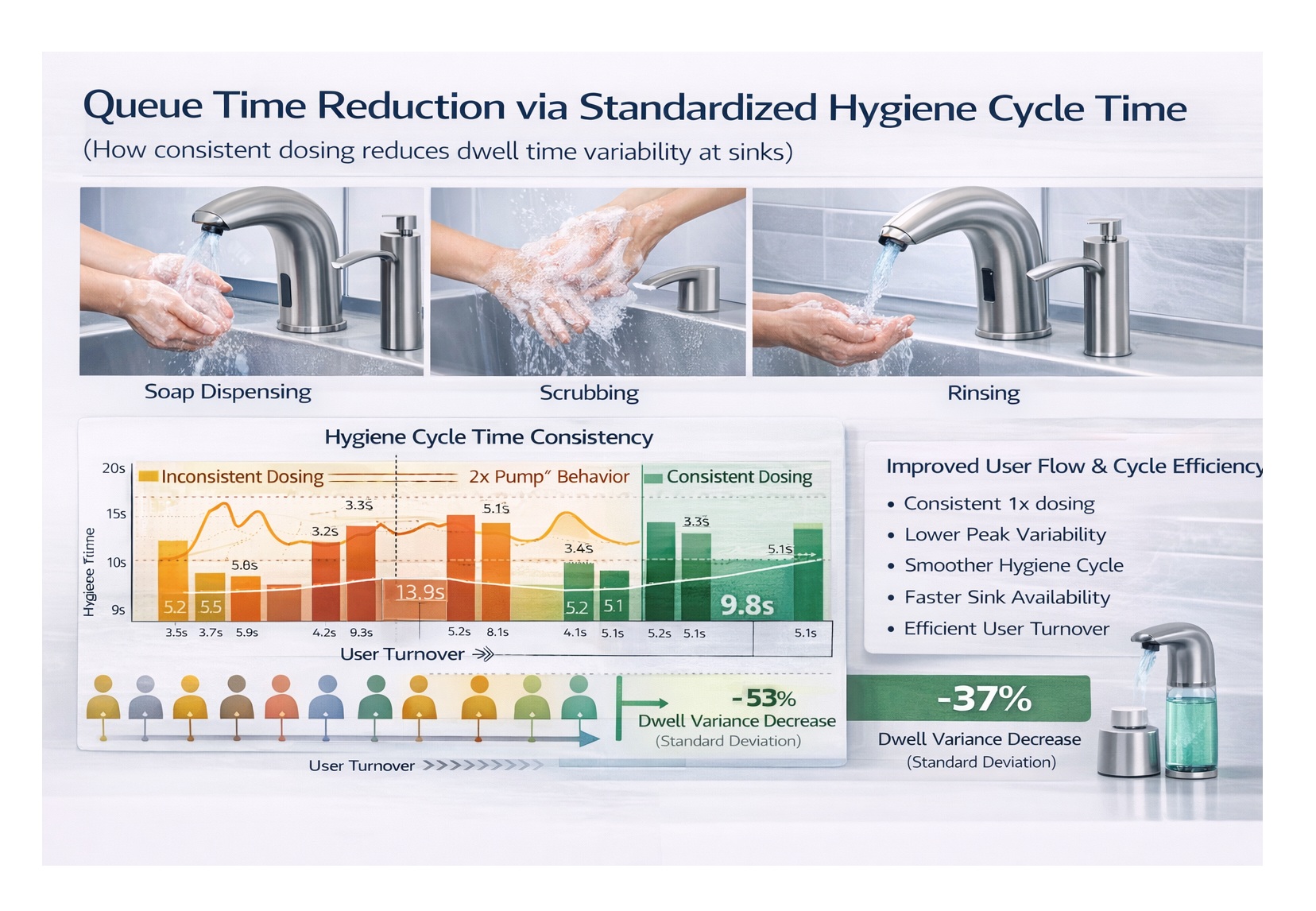
Infrared sensor dispensers reduce touchpoints and help facilities maintain a more standardized, reliable hand hygiene workflow. The biggest long-term advantage is repeatability. When every soap event dispenses a controlled dose consistently, teams can forecast refills and maintenance more accurately, reduce waste, and keep restrooms functioning smoothly during peak loads.
The CDC and WHO emphasize that effective hand hygiene plays a major role in preventing infection spread, which is why fixture-level handwashing performance is treated as a facility risk mitigation measure, not only a convenience upgrade.
Study and guidance sources
Touch-Free Hygiene & Sensor Technology Resources
Infrared sensor dispensers support cleaner, more efficient public restrooms by reducing surface contact, improving soap availability, and helping facilities maintain consistent hand hygiene routines. These resources provide useful background for hygiene planning, touch-free fixture specification, and commercial restroom performance.
CDC Clean Hands Guidance
CDC guidance explains why effective hand hygiene helps reduce germ transmission in public, healthcare, and institutional environments.
Visit CDC Clean Hands →CDC Hand Hygiene Guideline
Useful for understanding why soap access, handwashing behavior, and dispenser placement matter in high-risk and high-traffic facilities.
Review CDC Guideline →WELL Hand Washing Feature
WELL guidance connects handwashing access, hygiene support, and user-centered restroom design with healthier commercial interiors.
Explore WELL Hand Washing →NSF Plumbing Product Resources
NSF resources help specifiers understand testing, certification, and product safety considerations for commercial plumbing-related fixtures.
View NSF Resources →Infrared Sensor Dispenser Reference Library
Authoritative touchless soap dispenser resources, sensor-technology references, hygiene research, commercial restroom standards, plumbing engineering organizations, and facility-management authorities used to evaluate infrared sensor dispensers based on detection accuracy, dosing consistency, infection-control performance, maintenance efficiency, and long-term commercial reliability.
Infrared Sensor Technology Resource Center
Professional Resources for Infrared Sensor Soap Dispensers
Infrared sensor dispensers are widely specified in commercial restroom projects because they provide touch-free operation, predictable soap dosing, improved hygiene, and efficient maintenance planning. Explore the professional resources below to compare commercial products, integrated restroom systems, installation guidance, and engineering references for architects, engineers, contractors, and facility managers. :contentReference[oaicite:0]{index=0}
Infrared Soap Dispenser Collections
Integrated Touchless Restroom Systems
Installation & Technical Resources
Sensor Engineering Resources
Featured Infrared Sensor Hygiene Solutions
Commercial Infrared Soap Dispenser
Designed for high-traffic commercial facilities with accurate infrared sensing, consistent soap dosing, and dependable long-term operation.
View Model FS9818 →Commercial Sensor Faucet
Coordinate infrared soap dispensers with commercial touchless faucets to improve hygiene, throughput, and water efficiency.
View Commercial Sensor Faucet →Integrated Faucet & Soap System
Create a complete touchless handwashing station with synchronized infrared sensing and coordinated commercial fixture design.
Explore Integrated Systems →3-In-1 Touchless Washroom System
An integrated commercial hygiene solution combining an infrared sensor faucet, automatic soap dispenser, and hand dryer for modern restroom environments.
View 3-In-1 System →