
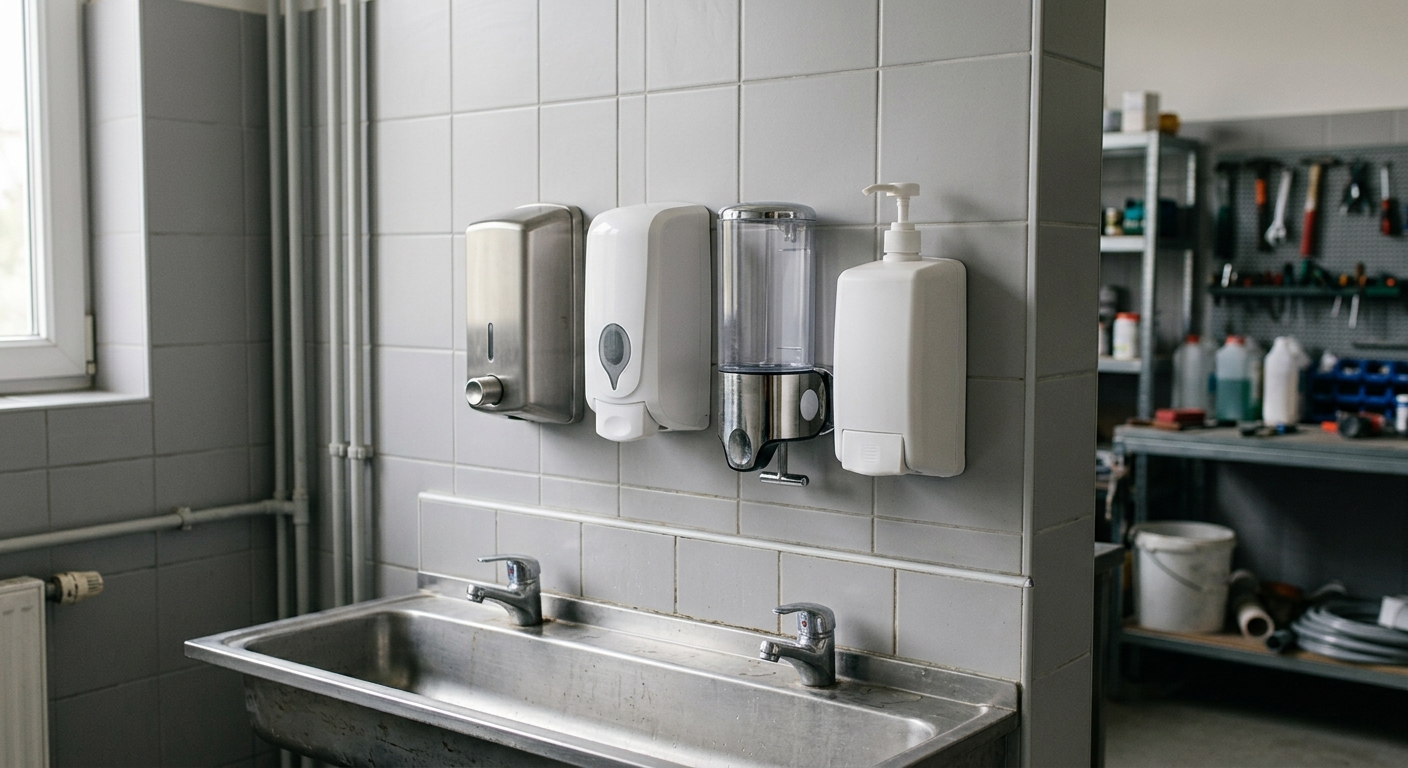
Standardizing soap dispensers across a portfolio comes down to one comparison: cost per wash versus cost per unit refill. A cartridge that looks cheap on the case price can lose to a bulk-fill system once you calculate dispensed volume per pump, and the reverse is just as common. Run the math per site type before you write a spec, because a formula that works for a 40-employee office often fails in a high-traffic restroom with 300 daily uses.
The true cost per wash, explained
Cost per wash is refill cost divided by number of washes the refill delivers. Number of washes is reservoir volume divided by dispensed volume per pump, adjusted for waste and priming loss (typically 3 to 5 percent for bulk systems, negligible for sealed cartridges since they meter more consistently).
Formula: (Refill unit cost) ÷ (Reservoir volume in mL ÷ mL per pump) = cost per wash.
Most wall-mounted dispensers deliver 0.4 to 1.2 mL of foam or 1 to 2 mL of liquid per pump, depending on the valve and whether it’s foam or lotion soap. Foam mechanisms stretch volume further because they aerate the product, which is why foam systems often win the per-wash comparison even when the concentrate costs more per liter.
Example: a 1000 mL bulk reservoir at 0.8 mL per pump yields 1,250 washes. If the refill costs a set amount, divide that cost by 1,250 to get true cost per wash. Do this calculation for every SKU under consideration before comparing case prices, because case price alone hides the pump-volume variable.
Bulk-fill vs cartridge: portfolio math
Bulk-fill systems have lower cost per mL of soap but higher labor cost (staff time to refill, higher risk of overfill waste) and higher contamination risk if reservoirs aren’t cleaned between refills. Sealed cartridge systems cost more per mL but reduce labor to a cartridge swap, eliminate reservoir cleaning, and give you a predictable per-wash number because the pump mechanism is factory-calibrated and doesn’t degrade with residue buildup the way bulk-fill valves can.
At single-site scale the labor difference is marginal. At portfolio scale, multiply refill frequency by number of restrooms by number of sites, and the labor line becomes the deciding factor more often than the soap cost line.
| Factor | Bulk-fill | Sealed cartridge |
|---|---|---|
| Soap cost per mL | Lower | Higher |
| Refill labor per unit | Higher (pour, clean, prime) | Lower (swap and go) |
| Contamination risk | Higher if reservoir not cleaned | Low, sealed system |
| Dispense consistency | Degrades as valve residue builds | Stable for cartridge life |
| Best fit | Low-traffic, single-site, in-house janitorial | High-traffic, multi-site, contracted janitorial |
If your portfolio spans both profiles, don’t force one system everywhere. Standardize by traffic tier instead of by brand: bulk-fill for back-office restrooms under roughly 50 uses a day, cartridge for lobby and high-traffic restrooms above that threshold. This gets you consistent hygiene performance where it matters and cost efficiency where volume justifies it.
Hygiene audit points for shared fixtures
Shared soap fixtures are a documented vector for cross-contamination when reservoirs are topped off rather than fully emptied and cleaned. Bacterial growth in bulk-fill reservoirs has been studied enough that “top-off” refilling is generally discouraged in favor of empty-clean-refill cycles. Build these checkpoints into your janitorial contract or in-house SOP:
- Reservoir cleaning interval: empty, rinse, and air-dry bulk reservoirs at each refill, not just when visibly soiled. Never top off on top of residual product.
- Refill source hygiene: bulk soap poured from an open jug that sits in a supply closet for weeks is a contamination risk in itself. Cap and date opened containers.
- Pump mechanism cleaning: wipe or replace pump heads on a set interval since biofilm can form on the nozzle regardless of reservoir type.
- Visual inspection log: cracked reservoirs, cloudy soap, or separated product should trigger immediate replacement, not wait for the next scheduled service.
- Cartridge expiration: sealed cartridges still have a shelf life once punctured or installed. Track install date, not just case-opened date.
- Touch-point audit: manual pumps are a contact surface. If you’re not moving to touchless, factor pump handle cleaning into the same schedule as door handles and faucet handles.
Document these as measurable intervals (weekly, monthly, per-service-visit) in the janitorial contract, not as vague “as needed” language. Vague language is what causes hygiene audits to fail during a site inspection.
Thread and mounting compatibility across brands
Wall-mounted dispensers vary more in bracket design than in supply thread, since soap dispensers don’t run off building plumbing the way faucets do. Most commercial units mount to a keyhole bracket or a backplate secured with two screws on a standard spacing, but bracket footprint is not universal across manufacturers. This is the detail that breaks a standardization plan: switching brands mid-portfolio without checking bracket compatibility means you’re either patching drywall or ordering vendor-specific brackets you didn’t budget for.
Before you standardize, get the bracket footprint (screw spacing, keyhole diameter, backplate dimensions) in writing from any vendor you’re evaluating, and confirm it against your currently installed brackets. If it doesn’t match, price the swap-out cost into your comparison, because that’s a one-time capital cost that changes the payback period on any refill-cost savings you calculated.
Countertop and pump-bottle style dispensers avoid this problem entirely since they don’t mount to the wall, but they introduce their own theft and tamper risk in public restrooms, which is a separate line item to weigh against wall-mounted units.
Rollout sequencing across multiple sites
Don’t convert every site at once. Sequence the rollout in three phases:
- Pilot at one or two representative sites covering both your low-traffic and high-traffic profiles. Run it for a full billing cycle to get real refill-frequency data, not estimated data.
- Validate the cost-per-wash model against actual consumption at the pilot sites. Your formula assumptions (pump volume, waste percentage) should be confirmed against real refill logs before you commit portfolio-wide.
- Scale by site tier, starting with sites nearing lease renewal or scheduled restroom renovation, where fixture swap-out labor is already budgeted for other reasons. This avoids a standalone capital project just for dispenser replacement.
Sites under existing bracket-compatible fixtures can be converted on the standard refill schedule with no capital cost. Sites requiring bracket or mounting changes should be batched with other planned maintenance to spread the labor cost.
Vendor consolidation vs local flexibility
A single national vendor gives you standardized SKUs, one invoice, and simpler audit tracking, but it locks you into that vendor’s refill pricing with less local leverage. Multiple regional vendors give you competitive pricing per market but complicate the cost-per-wash comparison since pump volumes and reservoir sizes may differ by supplier even within the “same” fixture category.
The practical middle ground: consolidate on fixture hardware (the dispenser body and bracket) with one manufacturer for compatibility, but allow regional flexibility on refill product sourcing as long as the refill meets your specified viscosity and reservoir-fit requirements. This keeps your mounting and audit standardization intact while letting procurement negotiate refill pricing regionally.
What to check before you sign a portfolio contract
- Run the cost-per-wash formula on every candidate SKU using actual pump-volume specs from the vendor, not marketing copy.
- Get bracket and mounting dimensions in writing and cross-check against your installed base before committing to a brand switch.
- Write reservoir cleaning and cartridge expiration intervals into the janitorial contract as measurable, auditable line items.
- Pilot at both a low-traffic and high-traffic site before scaling portfolio-wide.
- Decide your vendor consolidation split (hardware standardized, refill sourcing flexible) before RFP stage so bids come back comparable.