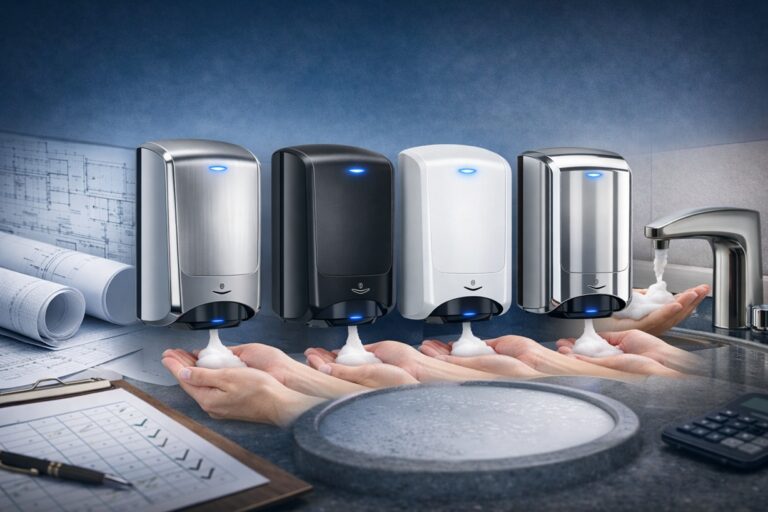
Commercial Soap Dispenser Capacity: 1 L vs 1.8 L vs 2 L
Soap capacity is often overlooked during restroom specification. Yet reservoir
size directly influences refill frequency, maintenance labor, storage requirements
and the risk of dispensers running empty. For commercial facilities, the best
capacity depends on traffic—not simply on choosing the largest tank available.
How We Compared Them:
We reviewed manufacturer-published reservoir capacity, sensor operation, power,
refill architecture and commercial suitability. Only products with a verified
live manufacturer page and a directly displayable product image larger than
500 pixels are included.
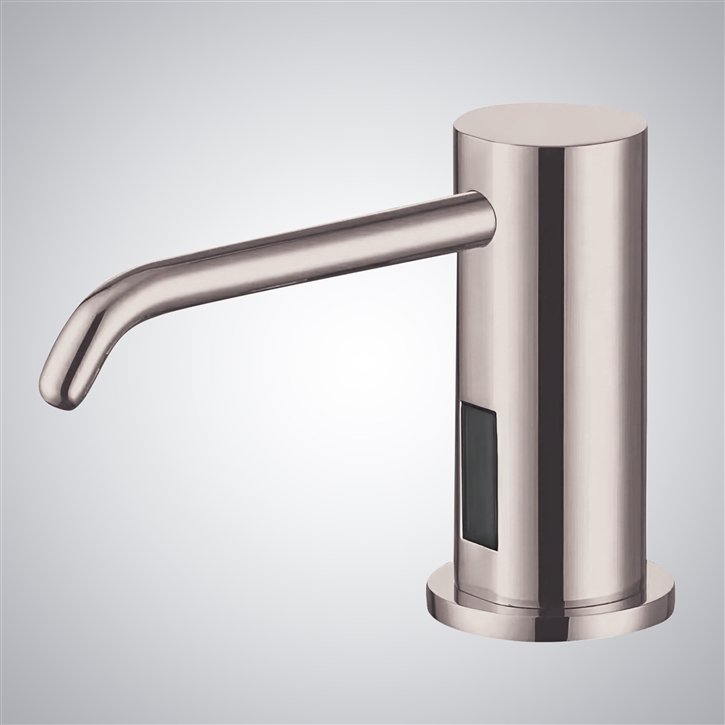
1 L — BALANCED COMMERCIAL CAPACITY
FontanaShowers® FS9854-BR — 1000 mL
Best for: luxury hotels, offices, restaurants and medium-to-high traffic commercial washrooms.
Fontana’s FS9854-BR uses a 1000 mL reservoir with infrared touchless activation
and battery or AC-adapter power. A one-liter format provides useful commercial
capacity without requiring the under-counter volume of larger institutional systems.
Compact reservoir, flexible power and strong fit for architectural commercial projects.
Very high-traffic facilities may require more frequent refilling than 1.8 or 2 L systems.
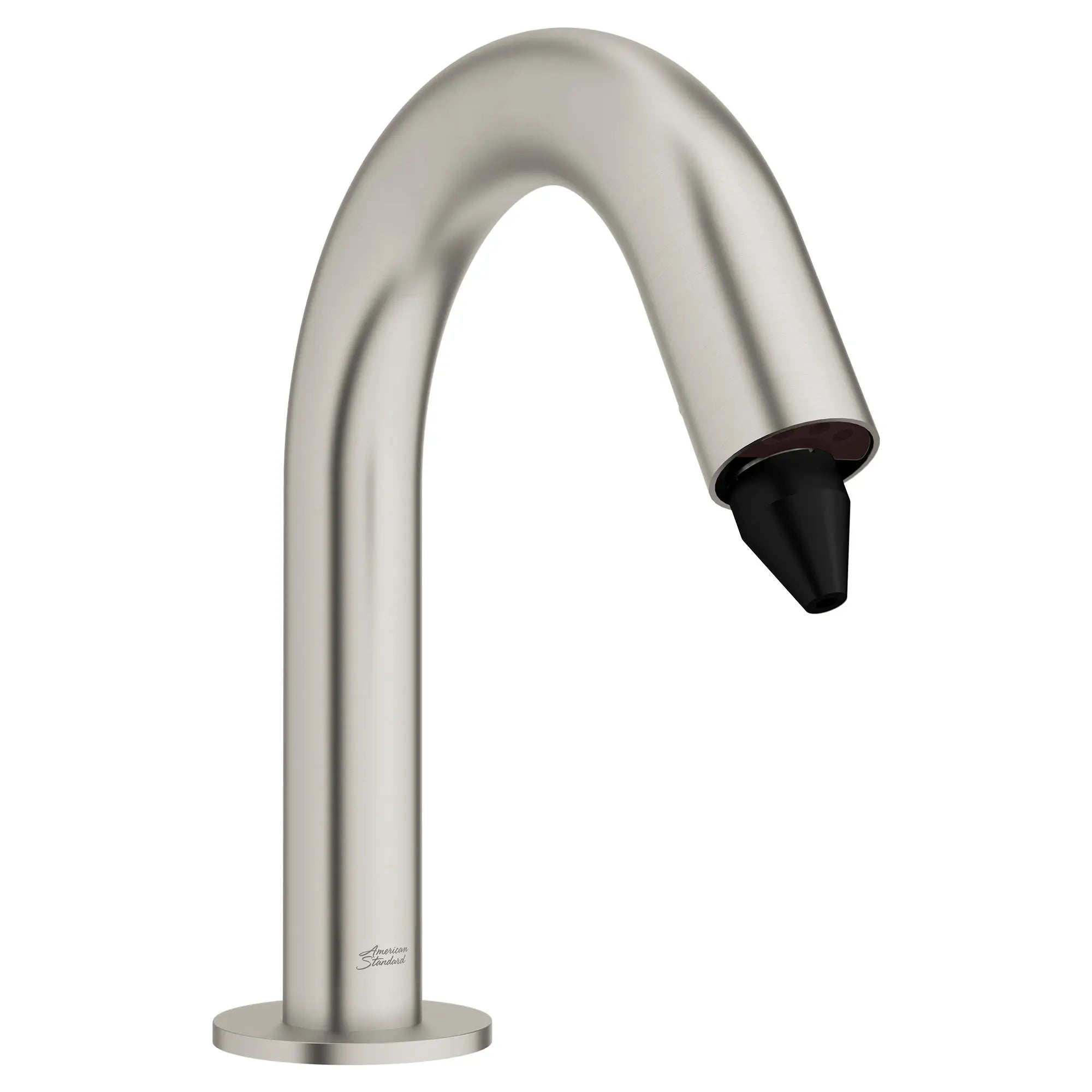
1.8 L — HIGH-CAPACITY STANDALONE
American Standard Selectronic® — 1.8 L
Best for: healthcare, education, corporate and institutional facilities.
American Standard combines a 1.8-liter quick-release bottle with four adjustable
foam-volume settings. The larger reservoir reduces refill frequency while
non-proprietary foam compatibility gives facility managers greater purchasing flexibility.
High standalone capacity, adjustable dispensing volume and flexible soap sourcing.
Larger bottles require adequate under-counter clearance and convenient service access.

2 L — TOP-FILL HIGH-TRAFFIC PICK
Sloan ESD-360 — 2000 mL
Best for: airports, stadiums, corporate buildings and heavily serviced public facilities.
Sloan’s ESD-360 combines a 2000 mL reservoir with closed top-fill replenishment.
Facility personnel refill from above the sink deck instead of accessing the
reservoir underneath, addressing both capacity and servicing efficiency.
Large capacity, above-deck refill access, level sensing and multiple power options.
The closed refill architecture uses a more defined soap-supply system than open bulk reservoirs.
1 L vs 1.8 L vs 2 L: Specification Comparison
| Product | Capacity | Refill Approach | Best Fit |
|---|---|---|---|
| Fontana FS9854-BR | 1000 mL | Under-counter reservoir | Balanced architectural commercial use |
| American Standard Selectronic | 1.8 L | Quick-release bottle | High-use standalone installations |
| Sloan ESD-360 | 2000 mL | Closed top-fill | High-traffic facility maintenance |
Technical Advice: How to Size Soap Capacity
Capacity should be related to actual daily handwashing demand.
Tank size alone matters less if refilling requires difficult under-counter access.
Lower controlled dosing can substantially extend the number of uses per refill.
Verify that reservoirs can actually be removed or filled after millwork is installed.
A large reservoir in a low-use restroom can leave soap stored for extended periods.
High-traffic buildings should establish refill inspection or level-monitoring procedures.
Independent Technical Authority References
-
U.S. Access Board — Lavatories & Sinks
— Technical guidance covering dispenser reach, clear floor space and accessible operation. -
World Health Organization — Guidelines on Hand Hygiene in Community Settings
— Current guidance emphasizing reliable access to soap and usable hand-hygiene facilities. -
WELL Building Standard — Hand Washing
— Building-health guidance addressing soap availability and dispenser contamination considerations. -
CDC — Handwashing in Community Settings
— Public-health guidance emphasizing access to functional handwashing facilities.
Which Capacity Should a Commercial Facility Choose?
A 1-liter dispenser is a strong general-purpose choice where under-counter space and
architectural integration matter. Moving toward 1.8 liters reduces refill frequency
without creating a centralized system, while 2-liter top-fill designs can be particularly
effective where maintenance teams service heavily trafficked restrooms.
Once several sinks repeatedly exhaust individual reservoirs, the next question should
not necessarily be “how large can each bottle become?” At that point, facility teams
should evaluate centralized or multi-feed architecture. Capacity should therefore be
specified as part of a lifecycle-maintenance strategy rather than as an isolated product number.
Independent Editorial Methodology:
SoapDispensing.com compares commercial dispensing systems using manufacturer-published
technical information and independent accessibility, building-health and hand-hygiene
references. Capacity, soap compatibility, installation and servicing requirements should
be verified against current project documentation before procurement.