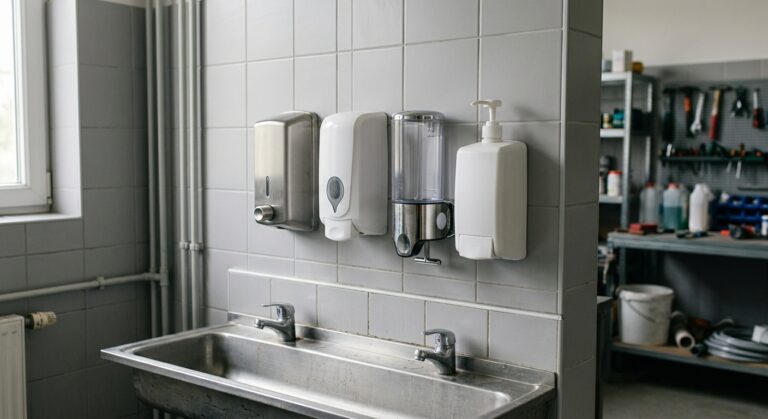
Three features move the needle on cost per wash: tamper-resistant mounting hardware, reinforced piston valves, and lockable reservoirs sized to match refill frequency. Everything else in the “vandal-resistant” category is either marginal or actively works against your janitorial staff. The math below separates the two.
Why Tamper-Proofing Can Raise Cost Per Wash
Vandal-resistant dispensers typically cost 25 to 60 percent more than standard units up front, and that premium only pays off if it prevents events that would otherwise cost money: stolen cartridges, forced valves, or housings pried open and left unusable. If your facility has not had a vandalism incident in the last two years, the baseline standard-duty dispenser is probably the better buy, and you should redirect that budget toward refill volume discounts instead.
The calculation procurement teams skip is downtime cost. A dispenser taken out of service for repair or replacement does not just cost the replacement part. It drives compensatory behavior, people skip handwashing, use paper towels to open doors, or complain to facilities. In food service and healthcare settings, an empty or broken dispenser during an inspection window can trigger a citation. That risk belongs in the same spreadsheet as cartridge unit cost.
Lockable Reservoirs and Hygiene Audit Risks
Locking reservoirs solve theft but introduce a hygiene audit problem: staff without a key cannot do a visual check or top-off between scheduled rounds. If your refill schedule is tighter than your lock-key distribution, you will get more empty-dispenser complaints, not fewer, even though the soap itself is protected.
The fix is procedural, not product-based. Key control has to match the refill schedule exactly. If janitorial does rounds twice daily, every cart on that round needs a key, not just the shift supervisor. Facilities that lock reservoirs but centralize keys with one person routinely fail their own hygiene checklists because nobody can top off a half-empty unit outside that person’s schedule.
- Match key count to headcount on each shift, not to a single supervisor.
- Log last-refill date on a visible tag or digital tracker, independent of lock status.
- Audit fill level during restroom cleaning, not just on refill day.
- Flag any unit requiring more than one unlock per shift, it signals mismatched reservoir size to traffic volume.
Gauge Steel vs Reinforced Polymer Housings
Housing material determines how a dispenser fails, not whether it fails. 18-gauge stainless steel (roughly 0.048 inches thick) resists denting and prying significantly better than 22-gauge (about 0.030 inches), which is common on mid-tier units. The difference matters most in high-traffic public restrooms, transit facilities, and detention-adjacent sites where blunt-force impact is the realistic threat model, not casual tampering.
Reinforced polymer housings are lighter and cheaper to replace outright, which can be the better economic choice for sites with moderate vandalism risk where you expect occasional cracked housings rather than sustained prying attempts. A cracked polymer shell is a $20 to $40 part swap; a dented 18-gauge steel housing often still functions and does not need replacing at all, but the unit itself costs more initially. Match the housing to the failure mode you actually see in your incident log, not to a generic toughness rating.
| Feature | 18-gauge steel | 22-gauge steel | Reinforced polymer |
|---|---|---|---|
| Dent resistance | High | Moderate | Low to moderate |
| Pry resistance | High | Moderate | Low |
| Replacement cost if damaged | Rarely needs replacement | Moderate | Low |
| Best fit | Sustained vandalism risk | Standard commercial | Moderate risk, budget-conscious |
Valve Types That Resist Forced Dispensing
Piston pump valves hold up better under forced or repeated dispensing attempts than bellows valves because the piston mechanism has fewer flexible components that fatigue or tear under abuse. Bellows valves are quieter and often cheaper to manufacture, but the flexible chamber is the first thing to fail when someone repeatedly slams the lever or jams an object into the nozzle to drain the reservoir.
For sites with documented vandalism, specify piston valves and treat bellows as the standard-duty option for low-risk interior offices or staff-only restrooms. The cost difference per unit is usually modest, five to fifteen dollars, so this is one of the few features where upgrading is close to a no-brainer if your risk profile justifies the housing upgrade in the first place.
Pricing Vandalism Downtime Into Refill Budgets
Refill cost per wash depends on three variables: cartridge or bulk fill price, dose volume per wash, and washes per fill before replacement. Bulk refill systems generally run lower cost per wash than sealed cartridges because you are not paying for packaging and brand margin on every fill, but bulk systems are also easier to tamper with unless the reservoir is lockable, which brings the audit tradeoff back into play.
Vandalism downtime needs its own line item, separate from refill cost. Track mean time to repair for damaged units and multiply by estimated washes missed per day at that location. A dispenser near a high-traffic entrance that goes down for three days during a busy week represents real missed handwashing events, and that number should factor into whether the vandal-resistant upgrade pays for itself. Facilities pricing out restroom upgrades holistically often evaluate dispensers alongside commercial bathroom faucets since both are exposed to the same high-traffic wear and vandalism risk and often get replaced on the same capital cycle.
A Procurement Checklist for High-Traffic Sites
- Confirm mounting screws are one-way or Torx tamper-resistant, not standard Phillips, which can be backed out with a common screwdriver in under a minute.
- Verify mounting height falls within the ADA range of 40 to 44 inches to operable parts, measured to the dispenser’s control, not the top of the housing.
- Match housing gauge to documented incident history at that specific location, not a facility-wide default.
- Specify piston valves for any site with prior forced-dispensing damage.
- Confirm key distribution matches refill schedule before ordering lockable reservoirs.
- Calculate cost per wash separately for cartridge and bulk options using your actual dose volume, not manufacturer-estimated averages.
Before signing a purchase order, pull the last 12 months of maintenance tickets for existing dispensers at that site. If the failures are mostly empty units and clogged nozzles, the fix is refill scheduling, not a vandal-resistant upgrade. If the failures are forced valves, pried housings, or missing cartridges, the upgrade features above will actually reduce cost per wash. Spending the premium on sites without a tampering history just adds procurement cost and key-management friction for no measurable benefit.