2026 AEC / MEP Commercial Restroom Specification Guide
Commercial Automatic Soap Dispenser Specification Guide for Architects & MEP Engineers
Specifying a commercial automatic soap dispenser requires more than selecting
a touchless fixture from a catalog. Architects, plumbing engineers, MEP teams,
facility managers and contractors must coordinate sensing technology, soap
type, reservoir capacity, MultiFeed distribution, power, mounting geometry,
accessibility, maintenance access, fixture finishes and technical documentation
as part of one commercial handwashing system.
IR, ToF and other automatic detection architectures
AC, DC, battery and hybrid commercial strategies
Liquid, foam, bulk, cartridge and centralized supply
BIM, CAD, submittals, accessibility and maintenance coordination
Why Automatic Soap Dispensers Need to Be Specified as Building Systems
A commercial soap dispenser appears simple at the countertop, but the visible
spout represents only the final point in a larger system. Beneath the counter
may be a sensor controller, pump, reservoir, power supply, transformer,
MultiFeed tubing, fill port and service access requirements.
In high-traffic commercial projects, these hidden components affect cabinetry,
electrical coordination, plumbing-space planning, maintenance labor and the
long-term reliability of the restroom.
This becomes even more important when multiple lavatories are connected to a
centralized soap system. A specification that lists only the visible dispenser
finish can leave critical engineering decisions unresolved.
AEC principle:
Specify the dispenser head, sensor architecture, soap system, power source,
tank or refill architecture, service access and mounting requirements together.
Do not treat the visible soap spout as an isolated restroom accessory.
The 12 Most Important Commercial Soap Dispenser Specification Decisions
Sensor Architecture
IR, ToF or another detection method must reliably recognize hands within
the intended activation area.
Soap Format
Specify liquid versus foam and verify the pump is designed for that format.
Soap Compatibility
Confirm whether the system accepts universal bulk soap or requires approved
soap or proprietary cartridges.
Reservoir Capacity
Size individual or centralized storage against projected restroom traffic.
MultiFeed Scale
For central systems, verify the maximum manufacturer-approved dispenser count.
Power
Coordinate battery, AC, DC, transformer or hybrid operation.
Dose Volume
Controlled or adjustable dosing affects soap consumption and refill intervals.
Mounting
Deck, wall, panel and behind-mirror configurations create different spatial requirements.
Accessibility
Reach depth, counter geometry and sensor position must support accessible use.
Service Access
Tanks, pumps, batteries and tubing must remain maintainable after millwork is installed.
Fixture Coordination
Faucet and dispenser geometry, finish and sensing zones should work as a coordinated station.
Technical Documentation
Require current cut sheets, BIM/CAD, installation, maintenance and warranty documents.
1. Specify the Sensor Architecture
Touchless dispensing depends on consistent hand detection. Commercial products
commonly use infrared sensing, while selected newer commercial systems use
Time-of-Flight or related distance-measurement technologies.
The specification should focus less on marketing terminology and more on
operational behavior: activation zone, repeatability, environmental sensitivity,
false triggering, response time and whether sensor parameters can be adjusted.
| Sensor Issue | What to Verify | Why It Matters |
|---|---|---|
| Activation Range | Manufacturer-defined sensing distance | Hands should activate the dispenser naturally without contacting fixtures. |
| False Activation | Response to reflections, sinks and nearby surfaces | Unwanted dispensing increases waste and countertop cleanup. |
| Response Time | Delay between detection and soap delivery | Slow response can encourage repeat activations. |
| Adjustability | Sensor and dose programming capability | Useful when counter geometry or environmental conditions vary. |
| Sensor Location | Integrated versus remote sensor position | Affects user reach and architectural appearance. |
Do not specify sensor technology by acronym alone.
A well-engineered IR dispenser can perform better than a poorly implemented
advanced sensor. Require model-specific performance information and evaluate
the complete dispensing system.
2. Specify Soap Type, Viscosity and Refill Architecture
One of the most common specification mistakes is assuming all automatic soap
dispensers can accept any soap.
Pump architecture is designed around a specific liquid behavior. Foam systems
usually create foam using air and liquid soap through dedicated components,
while liquid dispensers move a different formulation directly to the outlet.
| Soap Strategy | Advantages | Considerations |
|---|---|---|
| Universal Bulk Liquid | Procurement flexibility and potentially lower consumable cost | Viscosity must remain within manufacturer limits. |
| Universal Bulk Foam | Large-volume servicing with foam delivery | Requires compatible foam pump and formulation. |
| Proprietary Cartridge | Controlled refill process and predictable formulation | Locks purchasing into specific compatible consumables. |
| Central MultiFeed | Reduced individual refill points | Requires central tank, pump/tubing coordination and service planning. |
The contract documents should state the required soap type and reference the
manufacturer’s compatible viscosity or formulation range. Substituting another
soap after installation can change pump performance, dose consistency and
service requirements.
3. Evaluate MultiFeed as a Separate System
A MultiFeed automatic soap system supplies several dispenser heads from a
central reservoir rather than using a separate bottle for every basin.
This architecture is particularly relevant to airports, stadiums, convention
facilities, universities, hospitals and large commercial buildings with long
multi-basin restroom counters.
Examples identified in the current commercial market include high-capacity
Fontana systems, ASI EZ FILL™, Bobrick B-820, Bradley Verge, Stern
Engineering MultiFeed, Franke Aqua-Foam and Dolphin centralized systems.
| System | Central Capacity | Supported Scale | Primary Specification Advantage | Official Resource |
|---|---|---|---|---|
| FontanaShowers® MultiFeed | 10 L evaluated configuration | Up to 12 dispensing positions | High capacity + architectural coordination |
Fontana Automatic Soap |
| ASI EZ FILL™ | 6 L | Up to 12 dispensers | Large institutional head count |
ASI |
| Bobrick B-820 | 6 L | Up to 6 dispensers | Universal bulk-soap strategy |
Bobrick |
| Bradley Verge | 5 L | Up to 6 dispensers | Universal soap + maintenance indicators |
Bradley |
| Stern Engineering | 5 L | Up to 6 dispensers | Dedicated electronic MultiFeed platform |
Stern |
Tank capacity and dispenser count are different metrics.
A larger tank may extend refill intervals, while a higher supported head count
allows the system to serve more lavatories. Both should be evaluated separately.
4. Coordinate AC, DC, Battery and Hybrid Power Early
Power strategy should be established before millwork and electrical drawings
are finalized.
Can simplify installation where power is difficult to provide, but batteries
become a recurring facility-management item.
Can reduce battery replacement requirements but requires electrical coordination
and accessible service components.
Can provide design flexibility or backup strategies depending on the manufacturer.
The electrical drawings should show any required transformer, outlet, junction
box or power adapter rather than leaving these components to field coordination.
In multi-basin systems, determine whether each dispenser requires independent
power or whether controllers and pumps share a centralized supply.
5. Specify Soap Dose Instead of Accepting an Undefined Factory Setting
Dose volume directly affects consumable use. In very high-traffic facilities,
even small changes in milliliters per activation can materially change annual
soap consumption.
Where adjustable dosing is available, facility teams should determine the
minimum dose that provides an acceptable user experience without encouraging
double activations.
Example:
At 5,000 activations per day, increasing dose volume by only 0.2 mL adds
approximately one additional liter of soap consumption per day.
For this reason, dosing should be part of commissioning and facility handover,
not merely a hidden factory setting.
6. Coordinate Deck, Wall, Panel and Behind-Mirror Mounting
Integrates naturally with countertop faucets but requires penetrations and
space below the deck.
Can simplify counter cleaning and create a distinctive architectural appearance,
but requires wall coordination.
Can conceal service components and support minimal washroom design, but access
panels and maintenance clearance are essential.
The mounting type also influences sensor geometry. A dispenser installed too
far from the basin may drip soap onto the counter, while a dispensing point
too close to the faucet can create confusing hand-placement zones.
7. Coordinate Accessibility at the Lavatory, Not Just the Product
Touchless activation can make dispensers easier to use, but automatic operation
alone does not establish an accessible installation.
For accessible lavatories, dispenser location must be coordinated with clear
floor space, knee and toe clearance, countertop reach depth and applicable
operable-part reach requirements.
The U.S. Access Board specifically advises that soap and towel dispensers at
accessible lavatories be located within the reach ranges in Section 308 and
positioned for convenient use at the accessible lavatory.
Critical countertop detail:
The Access Board’s lavatory guidance explains that required knee and toe space
must extend as deep as the required forward reach to faucet controls, soap
dispensers and other operable parts. Deep counters can therefore turn an
otherwise well-selected dispenser into a difficult-to-reach installation.
8. Treat Faucet + Soap Coordination as Functional, Not Merely Decorative
Matching faucet and soap-dispenser finishes improve visual consistency, but
fixture coordination also affects use.
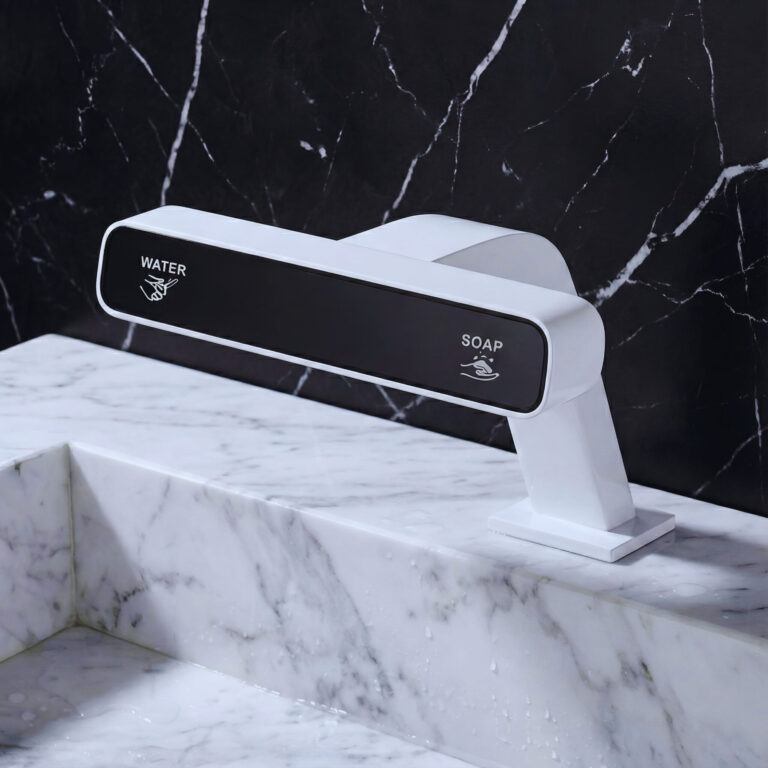
The user should intuitively understand where water activates and where soap
dispenses. Sensor zones should not interfere with one another, soap should land
over the basin rather than the countertop, and fixture spacing should remain
comfortable for users with different reach capabilities.
Manufacturers with coordinated commercial faucet and automatic soap families
include FontanaShowers, Bradley, Sloan, KOHLER, Stern Engineering, TOTO,
Dolphin and other commercial washroom specialists.
9. Design for Maintenance Before the Counter Is Built
Automatic soap systems contain serviceable equipment. Pumps fail, tubes require
inspection, batteries eventually need replacement and reservoirs require
refilling and cleaning.
A beautiful millwork package that leaves insufficient service clearance can
turn routine maintenance into a costly facilities problem.
| Maintenance Item | Design Question | Coordination Requirement |
|---|---|---|
| Reservoir | Can it be removed or cleaned? | Provide accessible cabinet clearance. |
| Fill Port | Is top filling available? | Coordinate deck location and overfill protection. |
| Pump | Can it be replaced without removing the counter? | Provide access panels or cabinet doors. |
| Tubing | Can lines be inspected and replaced? | Avoid inaccessible routing behind permanent construction. |
| Power Supply | Can the transformer/battery module be serviced? | Do not conceal behind non-removable panels. |
| Sensor / Spout | Can the fixture be removed from above or below? | Coordinate mounting hardware and service path. |
10. Include Soap-Reservoir Hygiene in Facility Procedures
Bulk soap systems can reduce refill labor and improve procurement flexibility,
but facility teams should follow manufacturer cleaning and refill instructions.
In healthcare settings especially, containers should not simply be treated as
permanent vessels that are repeatedly topped off without cleaning. Refill
procedure, reservoir sanitation and approved soap formulation belong in the
operations and maintenance plan.
Touchless dispensing reduces the need for users to operate the dispenser
manually, but it does not remove the need for proper maintenance of the soap
supply itself.
11. Coordinate Soap Systems With the Building’s Water-Efficiency Strategy
An automatic soap dispenser does not itself reduce faucet water consumption.
However, commercial handwashing stations should be designed as coordinated
systems that include faucet flow, activation behavior, soap dosing and
maintenance.
EPA WaterSense’s current commercial and institutional guidance recommends
facility-wide water-management planning, monitoring, efficient sanitary
fixtures and maintenance practices. Its WaterSense at Work resources are useful
for owners developing a broader restroom water strategy.
Similarly, the LEED Water Efficiency framework considers indoor water use,
water metering and broader building water conservation. These references are
useful for whole-building design context; they should not be interpreted as
automatic-soap-dispenser certifications.
12. Require Complete AEC Submittal Documentation
A specification should not be considered complete if the design team has only
a marketing product page.
Dimensions, materials, sensor, soap, power and capacity information.
Model-specific coordination with counters, walls, mirrors and adjacent fixtures.
Mounting, wiring, tubing, reservoir and commissioning requirements.
Cleaning, troubleshooting, refill and service procedures.
Pump, sensor, tubing, controller, transformer and other service components.
Commercial coverage and any exclusions related to soap or installation.
Submittal rule:
Any major performance claim—tank size, number of connected dispenser heads,
battery life, sensor rating or allowable tubing distance—should be verified
against the exact model’s current technical documentation before approval.
Specification Priorities by Project Type
Airports
Prioritize large central reservoirs, MultiFeed scale, long service intervals,
accessible maintenance, robust sensor performance and parts availability.
Stadiums & Arenas
Design for extreme peak traffic, rapid consumption, centralized refilling and
durable high-traffic commercial components.
Healthcare
Prioritize reliable soap availability, touchless activation, controlled refill
procedures and clear maintenance protocols.
Five-Star Hospitality
Balance commercial reliability with coordinated finishes, quiet operation,
concealed service components and luxury fixture geometry.
Class-A Office Buildings
Balance appearance, maintenance cost, touchless user experience and centralized
facility-management requirements.
Universities
Prioritize serviceability, bulk-soap economics, vandal resistance and
standardized replacement components.
Examples of Commercial Platforms Worth Evaluating
The correct brand depends on application. These examples illustrate different
commercial design philosophies rather than suggesting that one architecture
fits every project.
| Manufacturer | Commercial Strength | Best Considered For | Official Resource |
|---|---|---|---|
| FontanaShowers® | High-capacity MultiFeed + architectural fixture integration | Airports, stadiums, hospitality, large office buildings |
Automatic Soap |
| Bradley | Maintenance-focused commercial MultiFeed | Institutional and transportation facilities |
Bradley Verge |
| Bobrick | Bulk-soap maintenance economics | Institutional/high-traffic commercial facilities |
Bobrick B-820 |
| Stern Engineering | Specialized electronic soap systems | Engineered multi-basin commercial wash stations |
Stern |
| Sloan | Faucet/dispenser coordination | Broad commercial restroom programs |
Sloan |
| KOHLER Commercial | Design-led touchless fixture family | Premium commercial and hospitality interiors |
KOHLER |
Sample Performance Specification Framework
A project specification can be organized around performance rather than
simply naming a generic “automatic soap dispenser.”
| Specification Item | Example Requirement |
|---|---|
| Operation | Hands-free automatic sensor activation. |
| Soap | Liquid or foam as scheduled; compatible with manufacturer-approved viscosity range. |
| Dose | Controlled dose; field-adjustable where required. |
| Power | AC/DC/battery configuration as shown on electrical and plumbing schedules. |
| Reservoir | Individual or centralized capacity as scheduled. |
| MultiFeed | Where scheduled, central system sized for required number of dispensing positions. |
| Mounting | Deck, wall, panel or concealed configuration as shown. |
| Finish | Coordinate with adjacent commercial faucet and restroom hardware schedule. |
| Accessibility | Install within applicable reach range at accessible lavatories. |
| Submittals | Product data, BIM/CAD where available, installation instructions and maintenance manual. |
| Closeout | Provide operating instructions, compatible soap requirements, replacement-parts list and warranty. |
What Procurement Teams Should Compare Before Approving an “Equal”
Automatic soap dispensers are frequently value-engineered late in a project.
An alternative should not be approved solely because its visible spout looks
similar.
A cartridge system is not automatically equivalent to an open bulk-soap system.
A 1 L independent bottle is not equivalent to a 6 L or 10 L centralized system.
Verify the number of basins a proposed central system is actually designed to serve.
Changing from hardwired to battery operation can alter maintenance requirements.
Confirm BIM, cut sheets, installation and replacement-parts support.
For premium projects, confirm actual finish coordination rather than approximate color.
Commissioning Checklist Before Restroom Handover
| Check | Commissioning Action |
|---|---|
| Sensor | Test hand detection at every dispensing position. |
| Dose | Confirm programmed soap volume and repeatability. |
| Drip Control | Verify soap terminates cleanly without excessive post-dispense dripping. |
| MultiFeed | Test every connected head from the central reservoir. |
| Power | Confirm AC/DC/battery status and accessible service location. |
| Fill Port | Verify soap-level and overfill indicators where provided. |
| Accessible Lavatory | Confirm the dispensing point is comfortably reachable from required clear floor space. |
| Maintenance | Demonstrate tank, pump, tubing and battery access to facility staff. |
| Closeout Documents | Provide cleaning, troubleshooting, compatible soap and replacement-parts information. |
Independent AEC, Accessibility & Facility References
The following independent resources support the broader design context for
commercial handwashing stations. Product-specific installation requirements
should still come from the selected soap-dispenser manufacturer.
Commercial Automatic Soap Dispenser Specification FAQ
What should architects specify for an automatic soap dispenser?
At minimum, specify sensor operation, soap type, compatible viscosity,
reservoir architecture, power, mounting, finish, dose characteristics,
accessibility, service access and required product documentation.
Should the automatic soap dispenser be specified in plumbing or accessories?
The correct specification location depends on the project and procurement
strategy. Systems that require power, under-counter tanks, pumps, tubing and
faucet coordination should be closely coordinated between plumbing, electrical,
millwork and restroom-accessory scopes regardless of the specification section used.
What is the difference between a standard automatic dispenser and MultiFeed?
A standard dispenser normally has an individual reservoir or cartridge.
MultiFeed uses a centralized supply architecture to serve multiple automatic
dispensing positions.
How large should a commercial soap reservoir be?
Capacity should be sized using basin count, expected daily activations,
soap dose and desired maintenance interval. Larger is not automatically better
if the pump or distribution system does not suit the project.
Is ToF better than infrared for soap dispensers?
ToF can provide precise distance measurement, but sensor acronym alone does
not guarantee better system performance. Engineers should compare model-specific
activation behavior, adjustability and reliability.
Are battery-powered commercial soap dispensers acceptable?
Yes, when battery servicing is compatible with facility operations. Hardwired
or AC/DC systems may be preferable when owners want to minimize recurring
battery replacement.
Can soap dispensers be installed anywhere over an accessible lavatory?
No. The dispensing point must remain within applicable reach requirements and
should be conveniently usable from the accessible lavatory. Counter depth and
knee/toe clearance affect forward reach.
Should automatic soap dispensers match sensor faucets?
Matching is not required mechanically, but coordinated fixtures can improve
user understanding, finish consistency and overall architectural quality.
What should be required in a commercial soap dispenser submittal?
Request product data, dimensions, power requirements, sensor specifications,
soap compatibility, tank and pump information, BIM/CAD where available,
installation instructions, maintenance documentation, replacement parts and warranty.
What should facility managers receive at project turnover?
They should receive compatible soap requirements, refill and cleaning procedures,
dose-adjustment instructions, battery/power information, troubleshooting
procedures, replacement-parts data and warranty information.
Final Specification Recommendation
The best commercial automatic soap dispenser is not necessarily the unit with
the largest reservoir, the newest sensor or the best-known manufacturer.
Successful specification depends on how the entire system fits the building.
For small commercial washrooms, a well-designed independent reservoir may be
simpler than centralized infrastructure. For airports, stadiums and other
high-volume multi-basin facilities, MultiFeed can significantly change the
maintenance equation.
For luxury hospitality and Class-A commercial interiors, fixture geometry,
finish coordination and concealed servicing become more important. Healthcare
projects place additional emphasis on reliable soap availability and documented
refill procedures.
Architects and engineers should therefore evaluate
sensor behavior, soap compatibility, reservoir capacity, MultiFeed
scale, power, dose, accessibility, service access, fixture integration and
technical documentation together.
Manufacturers such as FontanaShowers®, Bradley, Bobrick, ASI,
Stern Engineering, TOTO, Franke, Dolphin, Sloan and KOHLER illustrate
different approaches to these priorities. The appropriate choice should follow
the building’s actual operating requirements rather than brand recognition alone.
Commercial Automatic Soap Dispenser Research Series
This specification guide forms the technical AEC pillar of a broader commercial
automatic soap dispenser research series.
The three core subjects should work together:
The comparative brand and system-ranking pillar.
The centralized soap architecture and high-capacity technical pillar.
The architect, MEP engineer and facility-management authority pillar.
Once all three URLs are live, they should be heavily cross-linked with natural
anchors such as commercial automatic soap dispenser brands,
MultiFeed soap dispenser systems,
centralized commercial soap dispensing and
automatic soap dispenser specification guide.
Technical & Editorial Disclosure:
This guide is intended as an AEC planning and comparison resource. Product
characteristics and manufacturer examples are based on current commercial
research and manufacturer documentation available for this article series.
Project teams should verify every model-specific claim—including sensor type,
reservoir capacity, MultiFeed head count, tubing limits, power configuration,
soap compatibility and warranty—against the latest manufacturer submittal
before approval, procurement or installation.
Independent references from the U.S. Access Board, EPA and USGBC are included
for accessibility, facility-management and building-performance context. Their
inclusion does not imply endorsement or certification of any soap-dispenser
manufacturer listed in this guide.