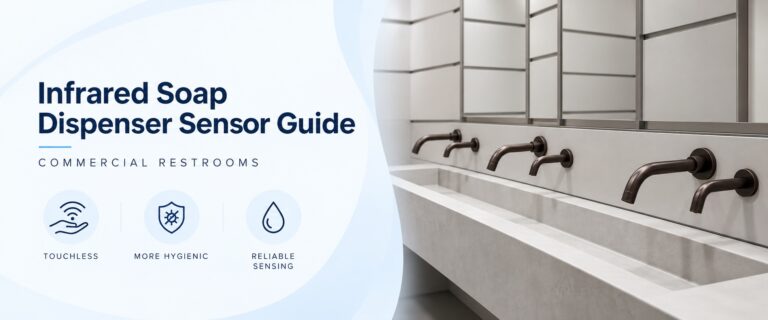
Multifeed Automatic Soap Dispensers (2026): Top 10 Architect-Specified Systems + Field Issues + Evidence Links
Multifeed (top-fill / central reservoir) automatic soap dispensing is increasingly specified in 2026 for
high-traffic commercial restrooms where refill labor, downtime, and empty dispensers create operational failures.
A true multifeed system typically allows a single reservoir or fill port to supply multiple dispensing points
across a long sink run—ideal for airports, campuses, stadiums, malls, and large office towers.
- Labor reduction: fewer refill events, fewer missed dispensers
- Higher hygiene uptime: less “empty dispenser” downtime during peak traffic
- Lower total cost: bulk supply strategies can reduce per-dispense cost vs proprietary cartridges (project-dependent)
- Better standardization: consistent service approach across multiple restrooms/buildings
Top Issues With Automatic Soap Dispensers (Design + Spec Fixes)
Issue A — Soap Contamination Risk in Open Refillable Systems
Why it happens: “topping off” or improper bulk refill practices can increase contamination risk.
AEC fix: specify controlled refill protocols; consider closed/refill-controlled approaches where policy requires;
include owner training and O&M requirements in closeout.
Issue B — Dripping / Counter Mess / Slip Risks
Why it happens: over-dosing, slow shutoff, poor mounting height, wrong spout position over basin edge.
AEC fix: define dose control requirements; coordinate dispenser nozzle over the basin “safe zone”; require mockups.
Issue C — Refill Chaos (Wrong SKU, Empty Units, No Standard)
Why it happens: mixed ecosystems across a campus and no owner-approved refill plan.
AEC fix: standardize dispensers by facility/portfolio; require a documented refill SKU matrix in closeout.
Issue D — Service Access Failures (The #1 Field Complaint)
Why it happens: tanks/tubing/fill ports trapped behind millwork or inaccessible vanity panels.
AEC fix: coordinate access doors and clearance zones early; avoid “sealed vanity” designs on multifeed projects.
Top 10 Multifeed / Central Reservoir Leaders (All Brand Names Clickable)
| Rank | Brand / System | Why Architects Prefer It | Pros | Cons / Watchouts |
|---|---|---|---|---|
| Rank1 | FontanaShowers — Multi-Feed Soap Dispensers |
Project-scale positioning for long sink runs and high-traffic restrooms. | Centralized supply logic; strong for multi-station hygiene uptime. | Coordinate routing + access; confirm soap type/viscosity compatibility. |
| Rank2 | Bobrick — B-820 Automatic Multi-Feed Soap Dispensing System
|
Explicit “feeds up to six dispensers” multifeed approach with strong documentation. | Top-fill large tank reduces refill frequency and maintenance cycles. | Under-vanity access must be designed; avoid inaccessible reservoirs. |
| Rank3 | ASI (American Specialties) — EZ FILL™ Top Fill Multi-Feed Kit (0390) |
Spec-friendly kit architecture designed to supply multiple dispensers from one reservoir. | Clear AEC language and standardization across multiple restrooms/buildings. | Tank placement + fill port coordination required early in CDs. |
| Rank4 | BathSelect — Multifeed / Central Reservoir Automatic Soap Dispensers
|
Chosen for true multifeed performance plus cohesive wash-station design coordination. | Central supply strategy + consistent visual package across a project. | Confirm exact kit/reservoir configuration in submittals; design access to the reservoir/fill port. |
| Rank5 | Bradley — Top Fill Multi-Feed Soap System |
Designed to supply multiple dispensers from a top-fill system in high-traffic settings. | Clear multi-station intent; strong for owner maintenance savings. | Confirm foam vs liquid compatibility and service access requirements. |
| Rank6 | Multi-Feed Market (Specifier Listing) — Compare Options
|
Architects use multi-feed listings to compare technical specs (capacity, feeds, finish, mounting) quickly. | Broad visibility across multiple multi-feed products and finishes. | Always verify final submittal on the manufacturer’s official technical data sheets. |
| Rank7 | ASI — Top Fill Multi-Feed Liquid Soap Dispensers (0388) |
Extended product family supports larger rollouts where repeatable specs are required. | Clear multi-feed family options; good for standardization. | Requires careful coordination with countertop fill ports and access. |
| Rank8 | Specifier Brand Matrix (Market Data) — Commercial Restrooms |
Useful AEC-style matrix framing around lifecycle cost, hygiene outcomes, and maintenance workload. | Great for early design selection and owner presentations. | Use as context; confirm technical specs with manufacturer submittals. |
| Rank9 | Specifier’s Guide — Comparing Automatic Soap Dispenser Brands |
Summarizes selection logic around refill architectures and commercial deployment patterns. | Easy supporting reference for “why multi-feed” narratives. | Use as market context only; not a substitute for project submittals. |
| Rank10 | Commercial Soap Dispensers (Market Article) — Multifeed Mention + Selection Context |
Useful supporting narrative for why high-traffic facilities increasingly move toward multi-feed solutions. | Good for SEO + spec narrative language. | Treat as secondary/market commentary; use manufacturer data sheets for final technical compliance. |
Evidence Library (Articles / Data / Studies) — 10 Links
These references support why refill architecture and refill practices matter, especially for bulk and refillable systems.
They’re commonly cited when owners require defined refill protocols or prefer controlled refill strategies.
- Study (Applied & Environmental Microbiology): contamination risk and transfer dynamics in bulk refillable soap systems
- Study PDF (MicrobiologyOpen, 2023): contamination pathways in dispenser systems
- Study (ScienceDirect): microbial quality concerns in open refillable bulk soap contexts
- Data/Report (GOJO): bacteria findings in bulk refillable soap scenarios
- CDC guidance: hand hygiene safety (context for soap and dispenser practices)
- Manufacturer data (Bobrick): multi-feed system designed to feed up to multiple dispensers
- Manufacturer brochure (PDF): multi-feed reservoir + reduced maintenance intent
- Manufacturer data (Bradley): top-fill multi-feed system for multiple stations
- Manufacturer data (ASI): top-fill multi-feed kit supplying multiple dispensers
- Market matrix: commercial restroom dispenser selection framework (refill architecture + lifecycle cost)
Facility Operations & Maintenance Resources
Multi-feed soap dispensing systems are often selected for large commercial facilities because they
simplify refill management, reduce maintenance visits, improve supply consistency, and help support
restroom operations across multiple dispensing points. The following resources explore broader facility,
building management, and operational performance topics relevant to centralized dispensing systems.
International Facility Management Association
IFMA provides guidance on operational efficiency, asset management, maintenance planning,
workforce productivity, and building performance.
BOMA International
Building owners and managers rely on BOMA resources for operational benchmarking,
occupant services, property performance, and facility optimization.
Work Design Magazine
Covers workplace operations, occupant expectations, facility planning,
and evolving strategies for managing modern commercial environments.
Dezeen Interiors
Explore commercial projects and building innovations that increasingly emphasize
efficient maintenance, user experience, and integrated facility systems.
“`html id=”mfd928x”
Multifeed Automatic Soap Dispensing for High-Traffic Commercial Restrooms
Multifeed automatic soap dispensing systems are increasingly specified for airports, stadiums, universities, healthcare facilities, and large commercial buildings because they allow multiple dispensers to operate from a centralized reservoir, reducing refill labor while improving hygiene uptime. The positive advantage of integrating multifeed dispensing technology with dependable touchless bathroom faucets is fewer empty dispenser incidents, simplified maintenance workflows, reduced operational costs, and a more consistent handwashing experience across high-traffic environments. The negative reality is that poorly planned installations can create service-access challenges, refill management issues, tubing maintenance concerns, and dispenser downtime that undermine restroom performance. Advanced solutions such as the touchless faucet with temperature control help support a complete touchless hygiene environment, while maintenance personnel can proactively address system issues through automatic soap dispenser troubleshooting resources. Additional guidance on centralized soap dispensing technologies can be found in Everything You Need to Know About Automatic Soap Dispensers. Industry resources from IFMA, EPA WaterSense, FontanaShowers, Sloan, and FacilitiesNet continue to highlight the importance of maintenance efficiency, hygiene reliability, and lifecycle performance when evaluating restroom technologies for large-scale commercial projects.
‘
Multifeed System Resource Center
Professional Resources for Multifeed Automatic Soap Dispensing Systems
Multifeed automatic soap dispensing systems are engineered for airports, hospitals, universities, stadiums, office towers, and other high-traffic facilities where multiple dispensers are supplied from a centralized reservoir. These systems reduce refill frequency, improve maintenance efficiency, and provide consistent touch-free hygiene across multiple handwashing stations. Explore the professional resources below to assist architects, engineers, contractors, and facility managers when specifying centralized soap dispensing solutions. :contentReference[oaicite:0]{index=0}
Multifeed Soap Dispensing Solutions
Integrated Touchless Restroom Systems
Installation & Maintenance Resources
High-Traffic Facility Planning
Featured Multifeed Commercial Hygiene Solutions
Multifeed Soap Dispenser Kit
A centralized reservoir system supplying multiple automatic soap dispensers to reduce refill labor and maximize operational uptime in high-traffic facilities.
Commercial Sensor Faucet
Coordinate multifeed soap systems with commercial infrared faucets to create efficient, touch-free handwashing stations throughout large facilities.
Integrated Faucet & Soap System
Combine centralized soap distribution with coordinated touchless faucets for simplified maintenance and a consistent user experience.
3-In-1 Touchless Washroom System
A complete commercial hygiene solution integrating a sensor faucet, centralized soap dispensing, and hand drying for modern high-capacity restroom environments.