
AEC Technical Article
5 Ways to Avoid Soap Dispenser Maintenance Problems
Soap dispenser maintenance problems can be reduced by controlling five areas: refill practices, soap compatibility, service access, power reliability, and preventive maintenance. In commercial facilities, recurring issues such as clogged pumps, inconsistent dispensing, sensor failures, leaks, and excessive service calls are often caused by incompatible soap chemistry, contaminated refill practices, poor installation access, unstable power, or inadequate cleaning procedures.
The operational stakes are not limited to tenant complaints. In many occupancies, reliable access to soap is part of the broader hygiene system that supports infection prevention goals and workplace sanitation expectations, including requirements for maintaining sanitary facilities and providing soap at handwashing stations under workplace sanitation rules such as 29 CFR 1910.141 and the continuously updated text in the Electronic Code of Federal Regulations for 29 CFR 1910.141. In healthcare and higher-risk environments, soap and dispenser performance also interact with guidance frameworks such as the CDC Clean Hands program and the WHO hand hygiene resources.
For architects, engineers, facility managers, and maintenance teams, preventing these problems during specification and commissioning is more effective than relying on repeated repairs after occupancy. This guide explains five practical ways to avoid soap dispenser maintenance problems and improve long-term reliability in high-traffic restrooms.
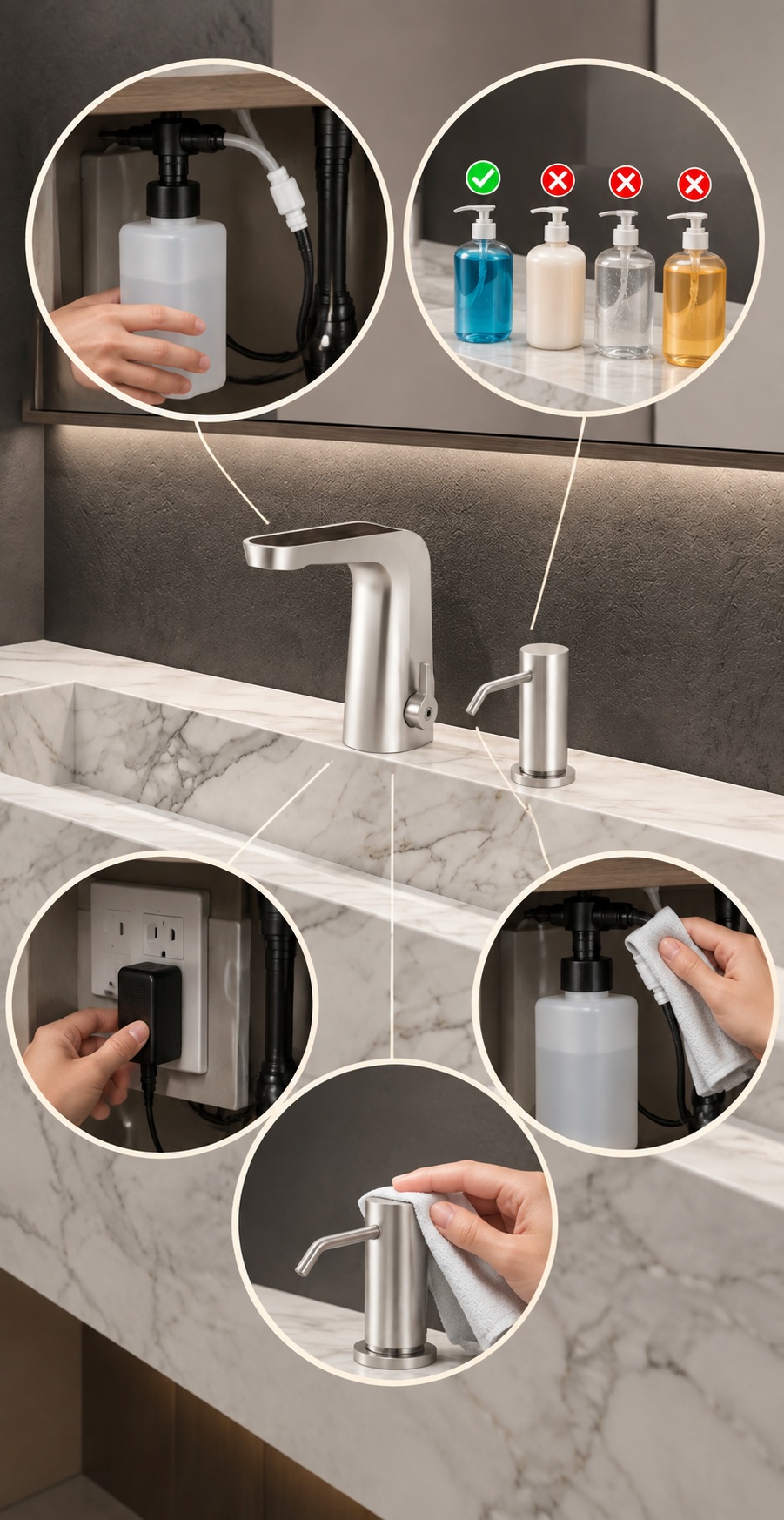
1) Avoid Soap Dispenser Maintenance Problems by Controlling Contamination Risk
1.1 Avoid Open Bulk Refill Practices Where Hygiene Risk And Maintenance Burden Are High
A leading driver of persistent maintenance problems is the “topping off” behavior common with open bulk refill dispensers. Beyond hygiene concerns, topping off accelerates clogging and pump inconsistency because mixed soap chemistries and dilution variability change viscosity and introduce residue formation at valves and nozzles.
Peer reviewed evidence has documented contamination and transfer risks associated with bulk refillable systems, including a controlled and in use study in Applied and Environmental Microbiology on bacterial hand contamination and transfer after use of contaminated bulk soap from refillable dispensers. Additional field research has surveyed microbial quality in open refillable bulk soap in food service environments, as described in a study on microbial quality of open refillable bulk soap and the influence of formulation factors.
For many commercial projects, the simplest reliability move is to specify dispensing architectures that reduce exposure pathways and standardize refill behavior. In practical terms, this often means sealed cartridges or controlled refill systems with defined cleaning procedures and documented compatibility.
1.2 Align Specification Language With Recognized Hygiene Guidance
WHO guidance materials emphasize system selection and handling practices as part of an overall hand hygiene program. Use language consistent with the WHO hand hygiene guidance collection, including operational prohibitions on topping off and requirements for cleaning dispensers before refilling when reuse is permitted by the system design.
1.3 Detail A Serviceable, Standardized Dispenser Family
To reduce parts variability and training overhead, specify a coordinated dispenser family across floors and restroom types, rather than mixing multiple brands and actuation methods. Coordinated families also make it easier to write clear O&M procedures and stock a limited set of consumables.
For projects that require touchless and coordinated aesthetics, a catalog structure such as the FontanaShowers Auto Soap Dispensers category can be used as a basis for identifying consistent formats and mounting types.

2) Control Soap Chemistry, Viscosity, And Material Compatibility
2.1 Treat Soap As A System Component, Not A Commodity
Many dispenser “failures” are actually fluid handling failures. Pumps, check valves, and nozzles are engineered for specific viscosity windows and pH ranges. When soap is substituted without verifying compatibility, symptoms typically present as slow dispense, drips, foaming instability, nozzle crusting, and sensor “false negative” behavior caused by residue at the outlet.
A practical reference point is the kind of compatibility guidance provided in manufacturer specification documents that explicitly state acceptable viscosity and pH ranges. For example, a MasterFormat-oriented cut sheet for soap dispensers may include defined soap property limits, such as the ranges noted in ASI’s Soap Dispensers MasterFormat document.
2.2 Prohibit Field Dilution Unless The Dispenser System Is Designed For It
Field dilution with tap water introduces uncontrolled mineral content, microbial risk pathways, and inconsistent viscosity, each of which increases clog risk and shortens pump life. Where dilution is unavoidable due to supply contracts, require a controlled mixing method and periodic line flushing procedures, and confirm that internal wetted components are compatible.
Installation and maintenance instructions often include flush requirements when changing soap types. Incorporate these requirements into Division 01 closeout, and reference manufacturer installation guidance, such as FontanaShowers automatic soap dispenser installation instructions or similar platform-specific instructions.
2.3 Specify Corrosion And Finish Performance Based On Cleaning Chemistry
Many facilities have clean dispensers with disinfectants that can damage finishes, degrade elastomers, and haze sensor windows. Coordinate dispenser finish selection with the owner’s cleaning protocol. Where the owner cannot commit to controlled chemistry, prioritize finishes and materials that tolerate aggressive cleaning and specify replaceable sensor windows or protective bezels where available.
Cleaning procedures should align with public health guidance. For non-healthcare public facilities, integrate scheduling and “high touch” identification consistent with CDC guidance on when and how to clean and disinfect a facility.
3) Engineer For Access, Power Resilience, And Commissioning Quality
3.1 Provide Maintainable Access Zones And Clear Mounting Constraints
Maintenance time increases sharply when dispensers are placed without regard to service clearances. Problems include obstructions to refill access in under-deck areas, inadequate clearance for battery trays, and fasteners that require special tools.
For deck-mounted configurations, coordinate dispenser shank locations with sink basin geometry, faucet reach, ADA reach ranges, and under-counter obstructions. Service access must be compatible with accessibility requirements and operable parts requirements. Cite the 2010 ADA Standards for Accessible Design and operability guidelines, such as the Access Board’s Chapter 3 operable parts guidelines.
3.2 Select A Power Strategy That Matches Occupancy Patterns
Battery-only deployments can be reliable if the facility has disciplined replacement cycles and clear low battery indicators. However, in high-traffic restrooms, battery depletion becomes a predictable source of downtime and service calls.
If possible, identify a power scheme with a power approach that will support the facility’s operations model. In cases involving hardwired or transformer-powered power schemes, power routing information and strain relief shall be required. If a battery override is provided, define which mode is primary and how switchover is indicated.
3.3 Require Startup Calibration And Functional Testing During Commissioning
Soap dispensers are commonly designed as a secondary system, not as a controlled device. This is why there may be problems with occupancy days in regard to sensor alignment, detection distance, or dosage.
Include a commissioning checklist item for each dispenser bank that verifies:
- Sensor detection distance under typical lighting
- Dispense volume consistency across repeated cycles
- Leak-free performance after refill
- Proper priming procedure documented and demonstrated
- Correct soap type installed, labeled, and recorded
For projects that rely on manufacturer procedures, reference installation and setup documentation such as FontanaShowers “How To Install Automatic Soap Dispensers” guidance.
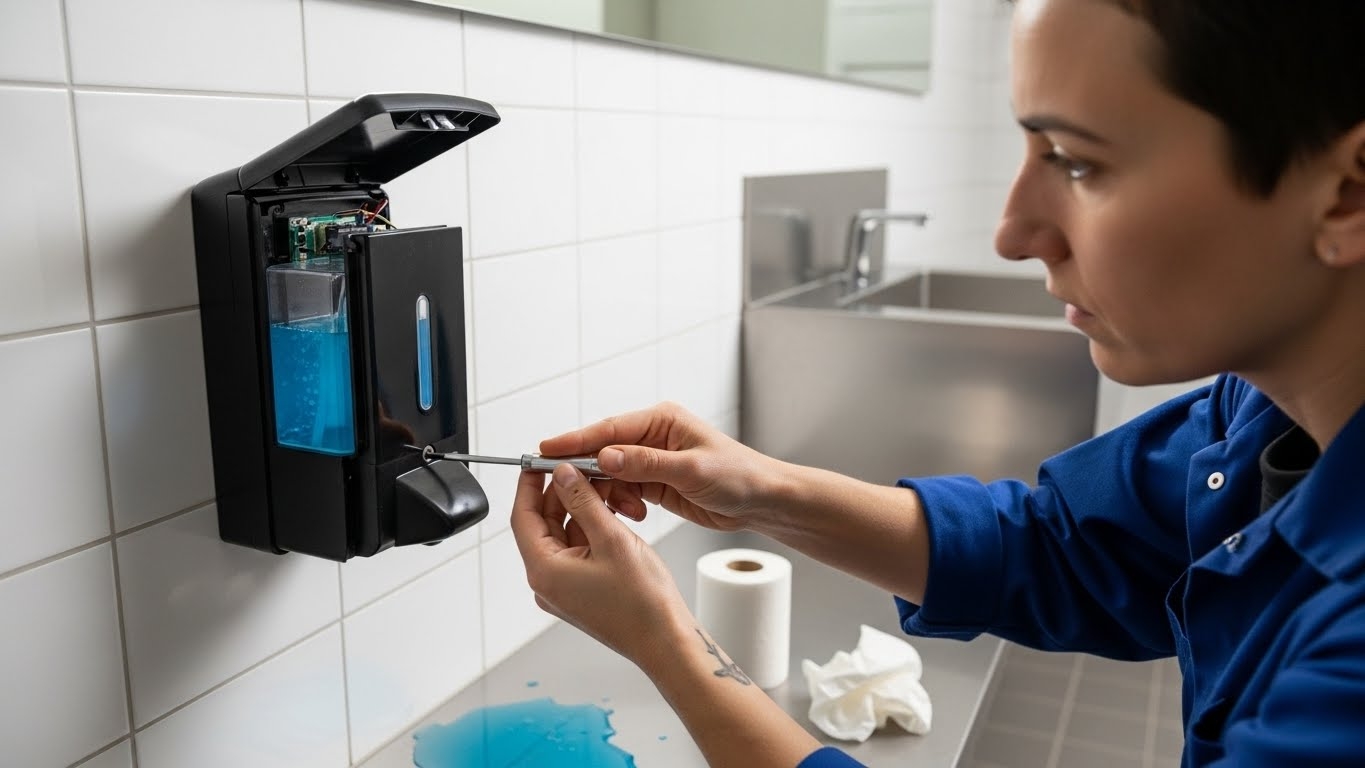
4) Build A Preventive Maintenance Program Around Known Failure Modes
4.1 Establish A Standard PM Interval And Trigger Based Actions
Reactive maintenance increases labor hours and causes repeated downtime. A preventive program should use both fixed intervals and trigger events.
Recommended PM structure:
- Weekly visual checks in high traffic restrooms: fill level, nozzle condition, sensor lens cleanliness
- Monthly functional tests: dispense volume, leak checks, actuation reliability
- Quarterly deep service: disassemble nozzle assemblies where designed for service, clean residue, and verify seals
- Trigger actions: full cleaning and flushing when changing soap chemistry, after a contamination event, or when recurring clogging is observed
4.2 Standardize Refilling As A Controlled Procedure
Where refillable systems are used, implement a written procedure that prohibits topping off and requires cleaning and drying steps before refill, consistent with hygiene-oriented guidance such as WHO hand hygiene resources and supported by contamination research, including the AEM paper on bulk soap refillable dispensers.
4.3 Stock Parts That Actually Fail, Not Just What Is Convenient
For most electronic or sensor dispensers, the highest value spares are:
- Pump modules or pump diaphragms
- Check valves and nozzle tips
- Battery packs or power adapters
- Sensor window covers or gaskets
Tie spares to the specified dispenser family to avoid mismatches. If a project uses multiple dispenser types, require a spares matrix in closeout documentation.
5) Integrate Cleaning Workflow, User Behavior, And Specification Controls
5.1 Treat Dispenser Reliability As Part Of The Facility Hygiene System
Soap dispensers should be included in the facility’s high-touch cleaning map. Over-wetting wiping, harsh solvents, and spray and pray disinfection can flood sensor areas and drive moisture into housings.
For general facilities, cleaning schedules should align with CDC facility cleaning and disinfection guidance. In healthcare settings, environmental cleaning practices may be more detailed and can reference frameworks such as CDC environmental cleaning procedures.
5.2 Use Clear Specification Language In The Correct Division Location
Soap dispensers appear across multiple divisions depending on project standards. To reduce scope gaps, place performance and maintenance requirements where the GC and subs will actually see them. A reference point for coordinated specification structure is MasterFormat language, such as Section 22 42 39 commercial soap dispensers and faucets.
5.3 Document A Change Control Rule For Soap Substitutions
Many post occupancy failures begin when a facility changes soap supplier without checking compatibility. Require a change control rule that triggers:
- Compatibility verification against viscosity and pH limits
- A one fixture pilot test
- A flush and clean procedure before system-wide change
Maintenance Problem Avoidance Matrix
| Maintenance Problem | Typical Root Cause | Design Or Spec Control | O&M Control |
|---|---|---|---|
| Clogging Or Slow Dispense | Soap viscosity out of range, residue formation, mixed soaps | Prohibit topping off, require flush when changing soap,s using procedures aligned with installation instructions | Periodic nozzle cleaning; replace the check valve |
| Check valve fouling, soap aeration issues, and residue at the tip | Seal degradation, chemical attack, over-tightening, and physical impact | Specify compatible materials and finishes; require serviceable assemblies | Quarterly seal inspection and replacement triggers |
| Sensor Does Not Trigger | Misalignment, dirty lens, power instability, reflections | Commission detection distance; define power strategy | Weekly lens cleaning and monthly functional testing |
| Excessive Drips After Dispense | Enforce no topping off; train staff using WHO-aligned practices and evidence from bulk refill contamination research | Specify check valve serviceability; avoid soap dilution variability | Periodic nozzle cleaning; replace check valve |
| Contamination Risk In Bulk Refill | Open refill, topping off, uncontrolled handling | Prefer sealed cartridges; define cleaning requirements | Enforce no topping off; train staff using WHO aligned practices and evidence from bulk refill contamination research |
Common Causes of Soap Dispenser Failures in Commercial Facilities
Most commercial soap dispenser failures are not product defects but system-level issues caused by improper refilling practices, incompatible soap chemistry, and inconsistent maintenance workflows. In high-traffic restrooms, even minor variations in viscosity, contamination during bulk refills, or neglected cleaning of sensor components can quickly lead to clogging, false activation, or complete system downtime.
From an AEC and facility management perspective, improving dispenser reliability requires a coordinated approach that aligns specification, operations, and preventive maintenance. When soap type, dispensing technology, and servicing procedures are standardized, facilities can significantly reduce service calls while maintaining consistent hygiene performance across all user conditions.
Conclusion
Avoiding soap dispenser maintenance problems requires treating the dispenser, the soap, and the servicing workflow as a single system. The most effective strategy begins with selecting a dispensing architecture that reduces contamination pathways and standardizes refilling behavior, supported by evidence documenting risks in open refillable bulk systems. Reliability improves further when soap chemistry and viscosity limits are defined, access and power strategies are engineered for the actual occupancy pattern, and commissioning is elevated to include calibration and functional verification. Finally, preventive maintenance and cleaning workflows must be codified in closeout documentation and reinforced through change control, so that seemingly small substitutions or refilling shortcuts do not become chronic failures.
When these five controls are implemented together, soap dispensers shift from frequent service liabilities to stable components of the building hygiene system, supporting facility operations and compliance expectations under workplace sanitation rules such as 29 CFR 1910.141 and accessibility frameworks such as the 2010 ADA Standards.
5 Ways to Avoid Soap Dispenser Maintenance Problems
Preventing soap dispenser maintenance problems begins with proper product selection, routine inspection schedules, compatible soap formulations, and coordinated restroom system design. The positive outcome of pairing dependable automatic dispensers with high-performance touchless bathroom faucets is improved hygiene compliance, reduced service interruptions, lower operating costs, and a more consistent user experience across airports, healthcare facilities, schools, office buildings, and hospitality environments. The negative reality is that neglected maintenance practices, incompatible soap products, sensor malfunctions, clogged dispensing mechanisms, and poor refill management can lead to dispenser downtime, user complaints, and increased labor expenses. Modern restroom solutions such as the touchless faucet with temperature control help support a seamless hygiene experience, while facility teams can proactively address recurring issues through resources such as automatic soap dispenser troubleshooting. Industry guidance from CDC, APIC, FontanaShowers, Sloan, and FacilitiesNet continues to demonstrate that long-term dispenser reliability depends on preventive maintenance, quality components, proper refill management, and integrated restroom planning rather than reactive repairs alone.
Maintenance Prevention Resource Center
Professional Resources for Avoiding Soap Dispenser Maintenance Problems
Preventing soap dispenser maintenance problems starts with selecting reliable commercial equipment, proper installation, routine cleaning, correct refill practices, and fast troubleshooting when sensor or dispensing issues appear. Explore the professional resources below to help facility managers, contractors, maintenance teams, and building owners reduce downtime, improve hygiene, and extend the service life of automatic soap dispensing systems.
Commercial Soap Dispenser Collections
Troubleshooting & Reset Support
Integrated Touchless Systems
Maintenance Planning Resources
Featured Maintenance-Friendly Soap Dispenser Solutions
Commercial Wall Mount Soap Dispenser
A dependable wall-mounted dispenser designed for easier servicing, reduced countertop clutter, and consistent touch-free operation in busy facilities.
View Model FS9818 →Automatic Soap Dispenser Reset Guide
Use reset and troubleshooting guidance to quickly address common sensor, battery, refill, and dispensing problems before they cause downtime.
View Reset Guide →Integrated Faucet & Soap System
Coordinate touchless faucets and soap dispensers to reduce maintenance complexity and improve the overall restroom user experience.
Explore Integrated Systems →3-In-1 Touchless Washroom System
An integrated hygiene solution combining sensor faucet, automatic soap dispenser, and hand dryer for simplified restroom maintenance planning.
View 3-In-1 System →Preventive Practices That Help Keep Automatic Soap Dispensers Operating Reliably
Most automatic soap dispenser failures can be prevented through proper maintenance planning rather than reactive repairs. In airports, hospitals, hotels, schools, office buildings, shopping centers, stadiums, and government facilities, maintenance teams that follow structured inspection routines experience fewer equipment failures, lower operating costs, and more consistent restroom performance. Preventative maintenance protects both the dispensing system and the overall user experience while extending the service life of commercial restroom equipment.
Prevent Problems Before They Affect Daily Operations
Successful commercial restroom maintenance begins with routine inspections instead of waiting for equipment to fail. Keeping sensor windows clean, verifying battery condition, inspecting soap reservoirs, using compatible refill products, and checking dispensing performance on a scheduled basis helps eliminate many common service issues before they interrupt restroom operation.
For facilities operating dozens or hundreds of dispensers, standardized maintenance procedures also simplify technician training, improve inventory management, and reduce emergency repair calls.
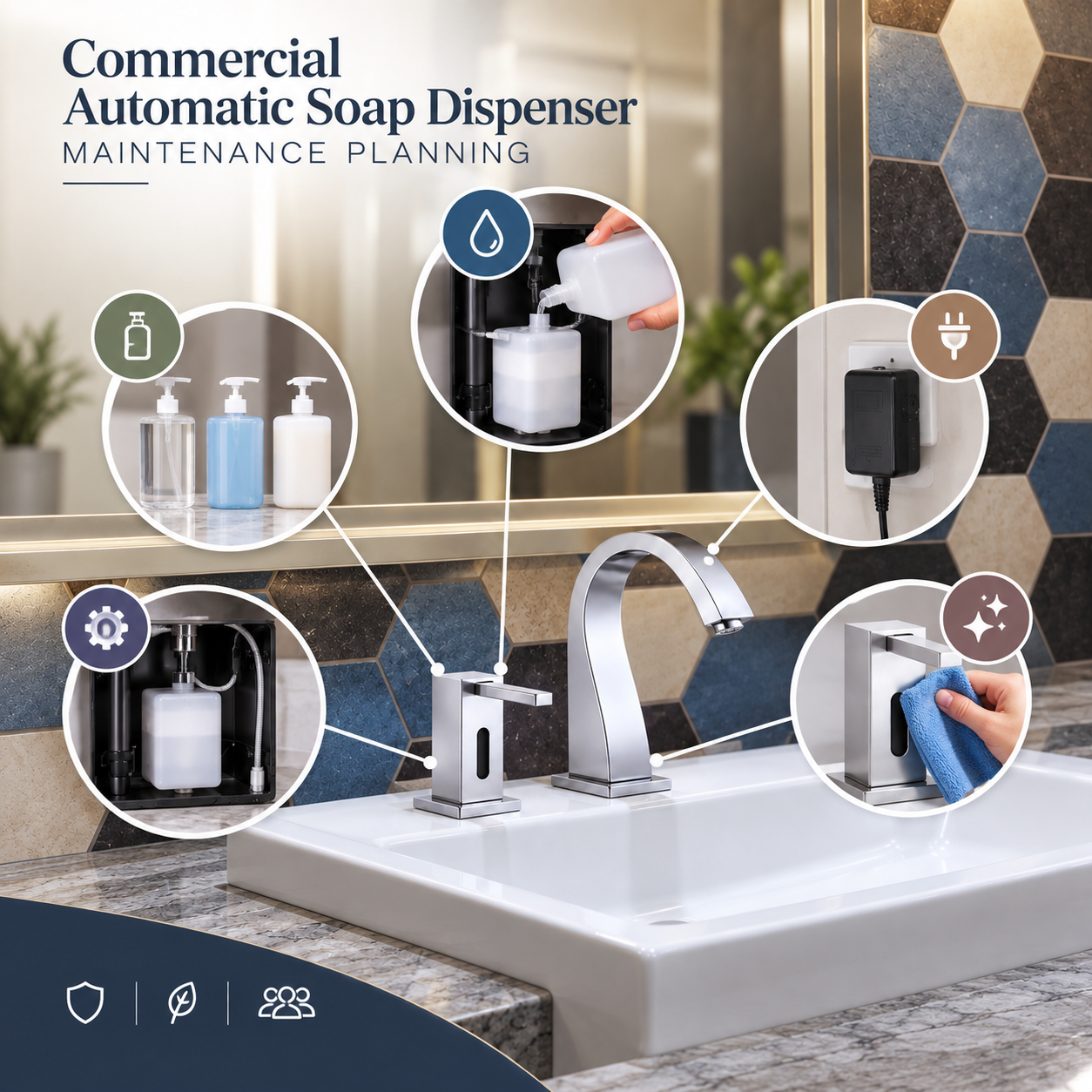
Standardization Simplifies Facility Management
Using the same dispenser platform throughout a commercial facility reduces spare-parts inventory, simplifies technician training, and creates consistent maintenance procedures. Coordinated touchless restroom systems also allow facility managers to schedule preventative service more efficiently while minimizing unexpected equipment failures.
Whether managing a healthcare campus, airport terminal, university, hospitality property, or office complex, preventative maintenance remains one of the most effective strategies for extending equipment life and improving restroom reliability.
Related Automatic Soap Dispenser Resources
-
Automatic Soap Dispenser Troubleshooting Guide
Learn how to diagnose common dispensing issues, sensor faults, pump problems, refill concerns, and preventative maintenance procedures. -
Best Automatic Soap Dispensers
Compare commercial automatic soap dispensers engineered for healthcare, airports, hotels, office buildings, schools, and public facilities. -
Commercial Touchless Soap Dispensers
Explore sensor-operated soap dispensing systems designed for demanding commercial environments requiring reliable daily operation. -
Liquid vs. Foam Soap Dispensers
Review how soap formulation influences maintenance frequency, dispenser performance, refill efficiency, and operating costs. -
Integrated Faucet & Soap Dispenser Systems
Discover how coordinated touchless restroom systems improve maintenance efficiency, simplify servicing, and support long-term commercial facility management.