Automatic soap dispensers specified for commercial restrooms must deliver repeatable dosing despite wide variation in soap rheology. Viscosity shifts occur across brands, antimicrobial additives, fragrance loads, temperature swings, aging in the reservoir, and shear thinning behavior during pumping. A fixed time or fixed speed pump drive can therefore drift into chronic under dosing or over dosing, which undermines hygiene intent, increases housekeeping interventions, and complicates life cycle cost planning.
Dynamic self calibration is the controls solution to this variability. It combines sensing and adaptive algorithms that learn how the installed pump and soap behave in situ, then automatically corrects each actuation to meet a defined dose target without technician reprogramming. For AEC applications, self calibration must also be specifiable, verifiable, and maintainable, with documentation that supports submittals and commissioning. Catalog level product selection for commercial projects commonly begins with a manufacturer category such as Fontana’s line of automatic soap dispensers.
Performance Requirements For Dynamic Self-Calibration
Dose Definition, Tolerance, And Repeatability
AEC grade performance should be defined as delivered volume per actuation, reported in milliliters and verified over repeated cycles. A practical specification approach includes:
- Target dose volume for liquid and foam configurations.
- Allowable deviation band, expressed as a percentage over a defined viscosity and temperature range.
- Repeatability requirements across a sample set of actuations after priming and during steady state use.
- Stability requirements after refill events and after extended idle periods.
A category and model selection page should provide enough product documentation to anchor submittals and commissioning expectations, such as the Fontana Soap Dispensers Collection.
Field Constraints In Commercial Restrooms
Self-calibration must function under constraints that commonly drive design and facility acceptance:
- Low false activation rate to limit nuisance dispensing and unintended consumption.
- Fast dispense latency to meet user expectations.
- Predictable power draw for battery-powered designs.
- Serviceability, including refill access, priming behavior, and protection against clogging.
Why Viscosity Variation Breaks Conventional Dosing
Open Loop Time Control Failure Modes
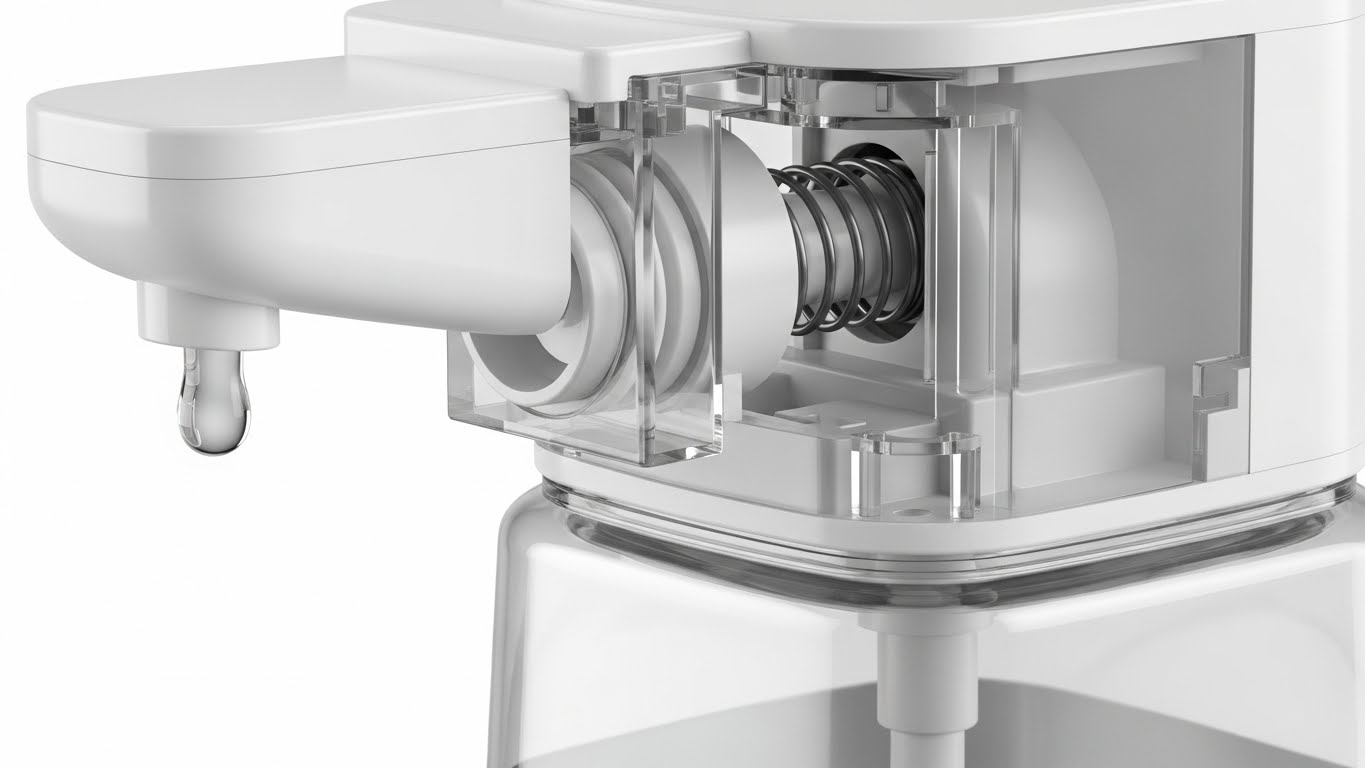
In an open loop dispenser, dose is frequently controlled by a fixed pump on time, sometimes paired with a fixed PWM duty cycle or fixed motor voltage. Delivered volume becomes a function of:
- Pump slip and internal leakage as viscosity changes.
- Pressure losses through tubing, outlet geometry, and check valves.
- Entrained air and incomplete priming after refill.
- Temperature dependent viscosity changes that alter flow resistance.
As viscosity rises, flow drops for the same drive command. As viscosity falls, over delivery and post dispense drips become more likely.
Non Newtonian Behavior And Short Pulse Nonlinearity
Many commercial soaps are shear thinning. During a short pulse, viscosity may drop under high shear in the pump chamber, then recover as flow decelerates. This creates nonlinear delivery that cannot be corrected reliably with a single static compensation factor. Consequently, self calibration must either measure delivery directly or infer delivery with higher confidence than a fixed timing assumption.
System Architecture For A Self Calibrating Dispenser
Hardware Elements
A robust self calibrating dispenser typically includes:
- A controllable positive displacement or peristaltic pump.
- A hand detection sensor, commonly infrared.
- A feedback method to estimate dose per actuation.
- A controller that can execute adaptive logic and store parameters nonvolatilely.
The self calibration problem is primarily software and sensing driven. However, pump selection matters because positive displacement pumps offer a more predictable flow to command relationship under varying viscosity than centrifugal type approaches.
Software Layers
An AEC ready implementation separates functions into layers:
- Intent Validation Layer: confirms a hand presence event and filters false triggers.
- Dose Control Layer: computes and executes the pump command required to meet the target volume.
- Calibration And Learning Layer: estimates soap behavior and updates model parameters over time.
This layered approach improves commissioning clarity because each layer can be verified independently.
Measurement Strategies That Enable Viscosity Adaptive Dosing
Strategy A: Motor Current And Speed As A Viscosity Proxy
Motor current correlates with torque. As viscous resistance and back pressure rise, required torque increases, and so does current. If motor speed is also estimated, the controller can infer a viscosity state and predict flow reduction before the dose error becomes visible.
Key advantages:
- No additional wetted sensors.
- Minimal added maintenance burden.
- Useful for rapid adaptation when soap type changes.
Key limitations:
- Battery voltage shifts can bias inference.
- Mechanical wear changes torque baseline.
- Ambient temperature affects both motor characteristics and soap viscosity.
This strategy is often a strong baseline when a project needs improved performance without adding in line sensors.
Strategy B: Direct Flow Sensing In The Dispense Path
A micro flow sensor provides closed loop volumetric feedback. The controller integrates measured flow and stops precisely at the target dose.
Benefits:
- Highest achievable dosing accuracy under varying viscosity.
- Strong resilience to aging, tubing changes, and partial restrictions.
Tradeoffs:
- Fouling and clogging risk in the wetted path.
- Additional cleaning and replacement considerations.
- Higher component cost.
This approach is most defensible in higher consequence environments, including healthcare and transportation hubs, where documented dosing accuracy can be treated as a performance requirement rather than a convenience feature.
Strategy C: Reservoir Trend Or Gravimetric Inference
Dose can be inferred by tracking reservoir mass or level changes over many actuations. Options include load cell, ultrasonic level sensing, or capacitive sensing.
Benefits:
- Provides long horizon calibration and consumption trending.
- Can detect empty conditions with higher reliability than purely motor based inference.
Limitations:
- Not typically precise enough for per actuation closed loop stopping.
- Requires filtering to address vibration, sloshing, and installation differences.
Strategy D: Hybrid Sensor Fusion
A practical AEC grade architecture uses hybrid sensing:
- Use motor current and speed to infer viscosity and set an initial pump command per dispense.
- Use periodic confirmation through flow sensing or reservoir trend to correct slow drift and aging.
- Apply bounded learning to avoid instability from anomalies.
Hybrid sensing achieves high accuracy without requiring flow sensors in every configuration.
Adaptive Control Methods That Eliminate Manual Reprogramming
Predictive Model Based Command Selection
Self calibration begins with a model that predicts volume per command:
- Delivered volume is a function of drive amplitude, drive duration, and inferred flow resistance.
- Flow resistance is estimated from motor current, speed, and temperature.
At each activation, the controller selects an initial command from this model. As a result, a sudden soap viscosity change does not immediately cause gross under dosing.
Closed Loop Trim For Dose Completion
Where direct measurement exists, the controller can trim in real time:
- Start dispense using the predictive command.
- Measure delivered volume continuously.
- Extend duration or adjust drive until the integrated volume equals the target.
- Stop with an anti drip profile.
This approach is the most direct way to maintain dosing accuracy independent of soap viscosity.
Continuous Learning With Bounded Updates
Learning must be stable. Updates should be applied only when confidence is high and bounded in magnitude:
- Ignore learning updates during abnormal events such as priming or air ingestion.
- Use low pass filtering or recursive estimation with conservative gain.
- Store learned parameters to nonvolatile memory for persistence after battery replacement.
This prevents oscillation where a temporary clog or a near empty reservoir incorrectly redefines the model.
Cold Start And Refill Robustness
After refill, entrained air and unprimed lines create unreliable dose estimates. A self calibrating dispenser should detect refill related states and run a controlled prime routine. It should also gate learning until stable delivery is confirmed. This is a decisive difference between adaptive logic that behaves well in laboratories and adaptive logic that holds performance in field installations.
Safeguards That Preserve Accuracy In Real Installations
Temperature Compensation
Temperature is a major driver of viscosity. A low cost temperature sensor near the reservoir improves model quality. Even with flow sensing, temperature compensation reduces the magnitude of real time trim, lowering energy draw and extending battery life.
Fault Detection And Diagnostic States
For specification and maintenance planning, the dispenser should detect and signal:
- Empty reservoir or dry run.
- Clogging or restriction, inferred from torque and flow mismatch.
- Sensor obstruction and repeated false trigger patterns.
Diagnostic signaling can be local LED states or remote telemetry depending on project requirements.
Anti Drip Cutoff Logic
To minimize drips, the control profile can implement:
- Short reverse pulse for peristaltic pumps, when mechanically supported.
- Rapid deceleration combined with a check valve closure profile.
Anti drip logic must remain within the pump manufacturer’s allowable drive conditions to avoid premature wear.
Comparison Of Self Calibration Approaches
| Approach | Feedback Basis | Accuracy Across Viscosity Changes | Maintenance Complexity | Suitable AEC Use Cases |
|---|---|---|---|---|
| Fixed timing open loop | None | Low | Low | Low traffic areas with controlled soap type |
| Adaptive open loop | Motor current and speed | Medium | Low | General commercial restrooms with variable soap supply |
| Closed loop control | In line flow sensing | High | Medium | Healthcare and mission critical applications |
| Hybrid sensor fusion | Current plus periodic confirmation | High | Medium to Low | Projects needing accuracy with serviceability |
Regulatory And Code Considerations For Specifiers
Accessibility Coordination
Dispensers are typically specified under restroom accessories and must be coordinated with reach ranges and operability requirements. Accessibility design teams often reference the 2010 ADA Standards For Accessible Design to align mounting heights, approach clearances, and operable parts expectations across the restroom accessory package.
Wireless And Telemetry Compliance For Connected Dispensers
If a dispenser includes wireless connectivity for monitoring, parameter logging, or facility analytics, it becomes subject to RF equipment authorization pathways. Specification language should require documentation aligned with the Federal Communications Commission guidance on equipment authorization, including the appropriate procedure for the embedded radio module and the final end product configuration.
For U.S. compliance traceability, design teams may also reference the regulatory framework in 47 CFR Part 2, Subpart J, which outlines authorization procedures and conditions for marketing RF devices.
Sustainability Coordination With Water Efficiency Programs
While WaterSense addresses faucets rather than soap dispensers, many projects specify touchless faucet and soap dispenser packages together. Water efficiency and performance intent can be aligned by referencing the EPA’s WaterSense product specifications and the program’s bathroom faucet guidance when coordinating overall handwashing fixture packages.
Conclusion
An auto soap dispenser can dynamically self calibrate for different soap viscosities without manual reprogramming by combining adaptive inference with feedback and robust learning safeguards. Motor current and speed sensing provide an effective proxy for viscosity, enabling predictive command selection that mitigates sudden soap changes. When direct measurement is available, closed loop control can stop precisely at the target dose, delivering the highest dosing accuracy across viscosity and temperature variability. Hybrid sensor fusion, which pairs rapid proxy inference with periodic volumetric confirmation, often provides the best balance of accuracy and maintenance demands for commercial installations.
For AEC teams, self calibration should be specified as a measurable performance outcome, supported by clear documentation, accessibility coordination, and compliance requirements for any wireless features. Product selection commonly begins with a documented commercial catalog such as Fontana’s automatic soap dispensers, then proceeds through performance based submittals that confirm dose accuracy across stated viscosity ranges.

No responses yet