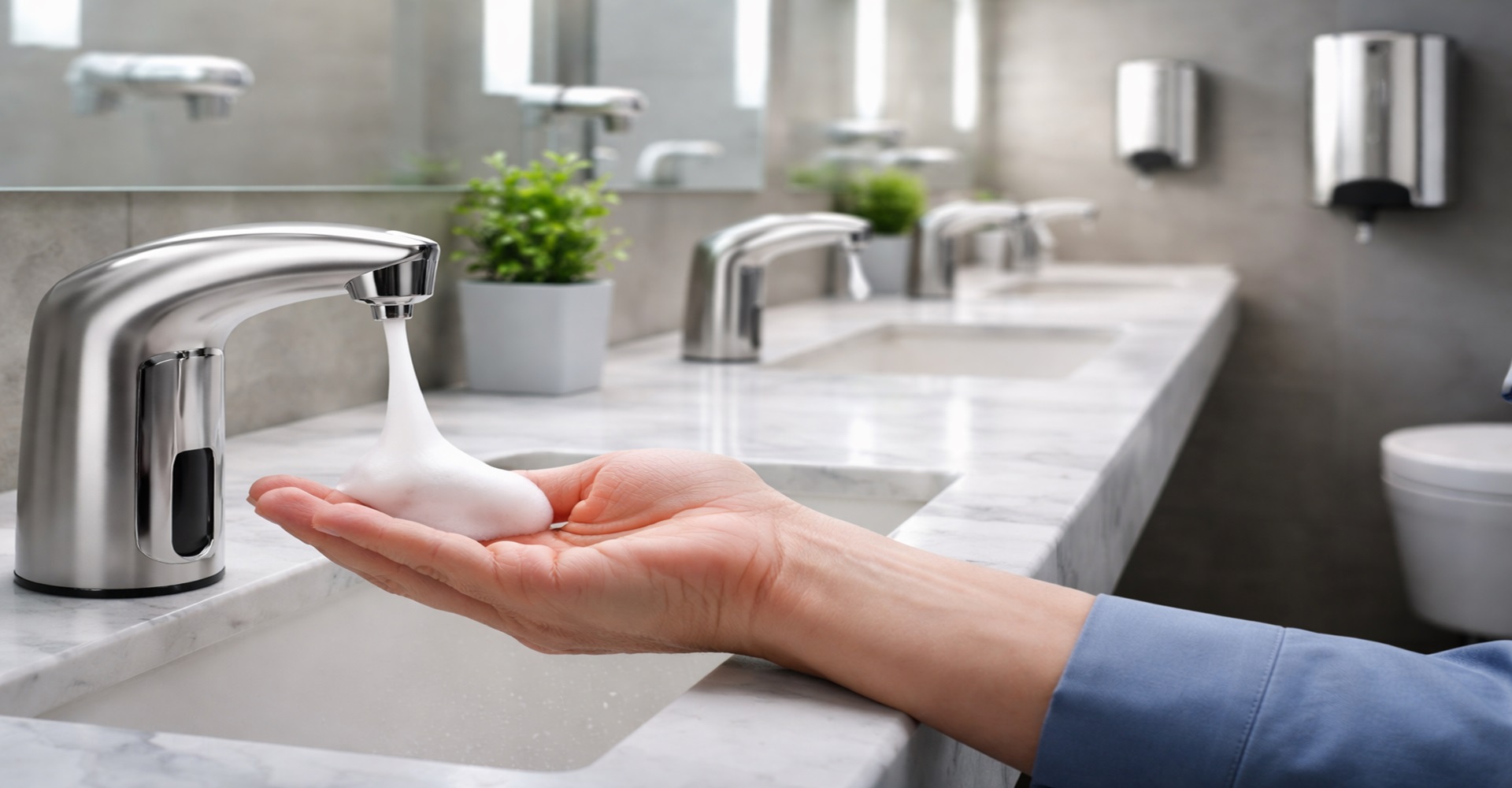
Automatic soap dispensers affect far more than restroom appearance. In commercial and institutional facilities, dispenser selection influences accessibility compliance, user hygiene outcomes, refill labor, consumables cost, vandal resistance, and downtime risk. A brand that performs well in light-duty applications can underperform in high-traffic environments if sensor behavior is unstable, dosing is inconsistent, or the pumping system is incompatible with the facility’s soap chemistry.
This article presents an AEC-focused approach to selecting an automatic soap dispenser brand using verifiable criteria: sensing performance, dosing repeatability, soap compatibility, mounting and power coordination, serviceability, and documentation quality. References are provided to representative Fontana product and category resources for schedule development, along with primary regulatory and guidance materials for accessibility and workplace sanitation.
Establishing The Basis Of Design Criteria
Defining The Operating Environment
The operating environment determines which technical characteristics matter most. A dispenser at an executive restroom serving a small occupant load will be evaluated primarily on reliability and finish consistency. A dispenser at a transit hub or stadium restroom will be evaluated on false trigger control, battery or power stability, rapid refill capability, and vandal resistance.
At a minimum, the basis of design should document expected peak use, standardization of soap types, available power provisions, and maintenance staffing assumptions. These inputs should be captured before selecting a brand and again before approving substitutions.
Confirming Soap Delivery Type And Chemistry
Soap delivery type affects pump design and long term performance. Foam-compatible dispensers use different internal components than liquid-only systems. Viscosity, additives, and particulate content can influence valve sticking, nozzle fouling, and dose drift.
A brand suitable for AEC specification should provide explicit statements about supported soap types, recommended cleaning or flushing practices when changing chemistry, and limits or warnings that protect the owner from unintended operating cost increases.
Sensor Performance And Dispense Control
Sensor Technology And Detection Envelope
Most automatic soap dispensers use infrared sensing, but identical sensor categories do not imply identical performance. Designers should evaluate detection envelope stability across ambient lighting, reflective basins, and background movement. False triggers increase soap consumption, create countertop contamination, and accelerate battery depletion.
During design review, the brand’s technical literature should clearly state detection distance behavior and whether detection settings are field adjustable. Where facilities require consistent performance across multiple rooms, adjustable settings can be an advantage for commissioning.
Lockout Timing And Repeat Dispense Behavior
After a dispense event, the control logic should prevent repeated firing due to lingering hands, reflective motion, or water spray. A stable lockout interval reduces waste and improves consistency of user experience in high occupancy settings.
When comparing brands, document whether lockout timing is factory set, adjustable, or adaptive. If a brand provides a coordinated touchless package, confirm that the soap dispenser behavior aligns with any paired touchless faucet shutoff timing to reduce confusion at the lavatory.
Dose Repeatability And Calibration
Dose repeatability should be treated as a measurable performance requirement. Inadequate dosage could lower hand-washing efficiency by limiting lather formation. Excess dosage could raise operating costs and even generate slippery floor areas around drips.
For AEC specifications, it shall be specified that the dose characteristics should be provided by the manufacturer, or it should be stated whether dose volume can be adjusted. In addition, it shall be specified that, if available, functions such as “calibration” or “priming” should be described within the operation manual accessible for maintenance personnel.
Mounting, Rough In, And Coordination Requirements
Wall-Mounted vs Deck-Mounted Selection

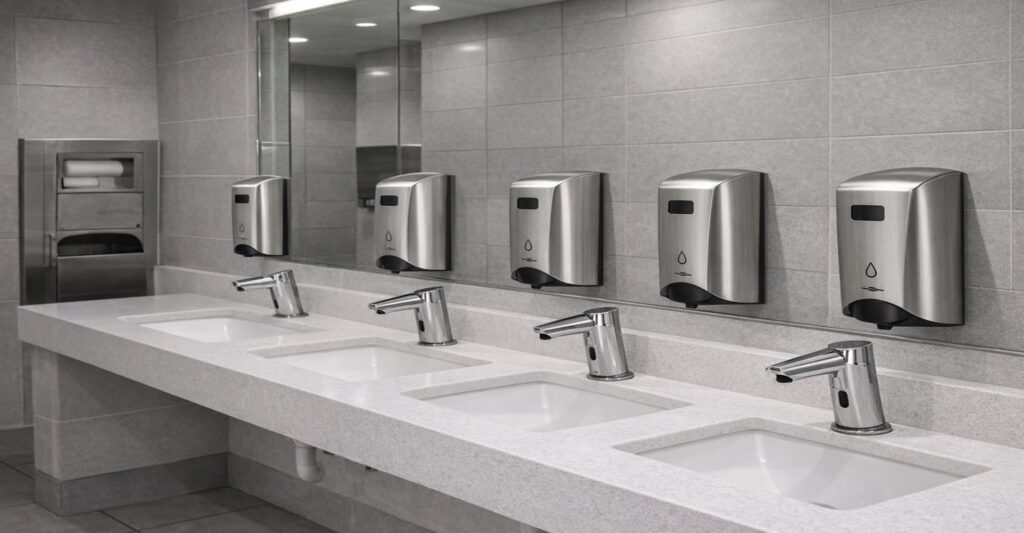
Wall-mounted dispensers make cleaning the decks easier and help declutter your countertop area. They also require proper wall backing, review of protrusion compliance, and wall finish assemblies. Deck-mounted dispensers require sink or countertop drilling coordination, under-deck clearance for bottles or tubing, and service access planning.
For schedule development and rough-in checks, the Fontana category page for Automatic Soap Dispensers can be used as a centralized reference to compare mounting types and typical commercial use cases.
Wall-Mounted Reference Condition
A representative wall-mounted condition can be reviewed using the Fontana Dax Wall Mounted Commercial Automatic Soap Dispenser. Use the product page to validate spatial envelope expectations, service access assumptions, and power input information that impacts electrical coordination.
Deck Mounted Reference Condition
A representative deck-mounted condition can be reviewed using the Fontana Automatic Sensor Deck-Mounted Commercial Liquid Foam Soap Dispenser. Use the listing to coordinate drilling, under-deck clearance, and refill access requirements with the sink and counter package.
Power And Electrical Compliance Considerations
Battery Power Versus Hardwired Power
Power strategy is a lifecycle decision. Battery systems reduce electrical scope and are common in renovations, but they require a realistic replacement plan and can produce nuisance failures if batteries are not replaced proactively. Hardwired systems reduce recurring battery labor but add scope for power supplies, routing, and service access.
Where a brand offers multi voltage power supply options, confirm input voltage requirements and the location and accessibility of the power module. For renovation work, ensure that power approach aligns with the owner’s staffing capacity and access constraints.
Electronic Device Emissions And Documentation
Automatic dispensers include electronics that may fall under FCC rules governing unintentional radiators. While not every project requires detailed emissions documentation at design stage, a brand suitable for commercial use should be able to provide compliance statements and appropriate product labeling information when requested.
For reference, the FCC’s unintentional radiator framework is presented in 47 CFR Part 15 Subpart B.
Accessibility And Code Alignment
Reach Range And Operable Parts
Soap dispensers located at accessible lavatories should be placed within required reach ranges and operable without tight grasping or twisting. The primary federal standard for accessible design in the United States is available through the Department of Justice as the 2010 ADA Standards For Accessible Design.
Design teams should treat dispenser placement as part of the accessible lavatory detail, not an afterthought delegated to field installation. Shop drawings should show centerlines and mounting heights with clear dimensioning.
Protruding Objects In Circulation Paths
Wall mounted dispensers can create protruding object hazards if they project too far into a circulation path between cane detectable heights. This issue is common in narrow toilet rooms, vestibules, and corridors adjacent to restroom entries.
The Access Board provides practical guidance in Chapter 3: Protruding Objects, which can be used during design review to prevent late stage compliance conflicts.
Protrusion Limits Under Commonly Adopted Standards
Many jurisdictions reference ICC A117.1 for technical accessibility criteria. Designers may view the limits of protrusion in the digital copy of ICC A117.1 Section 307.2.
Where bathroom fixtures cannot be laid out due to constraints, alternative mounting points, concealed installation, or safeguarded features that will be OSHA-compliant without creating hazards from tripping can be considered.
Hygiene Expectations & Operational Requirements
Alignment With Public Health Guidance
Although it is not specified which brands of water disposers the public health message prefers or recommends, it does emphasize the need to promote soap and water hand washing. For project narratives, especially in healthcare, education, and food-related occupancies, referencing established hand hygiene guidance can support the functional intent of dependable soap availability.
The CDC provides a clear summary in About Handwashing that can be used as a nonproprietary hygiene rationale in design documentation.
Workplace Sanitation Requirements
In employee facilities, workplace sanitation rules can influence how owners evaluate restroom support systems and maintenance programs. For U.S. workplaces, OSHA’s sanitation regulation is available as 29 CFR 1910.141.
Although this regulation does not mandate touchless technology, it allows consideration in the context of ensuring that washing stations are capable through the use of trustworthy dispensers and that maintenance is considered an operational issue as opposed to a service issue.
Serviceability And Total Cost Of Ownership Factors
Refill Architecture And Downtime Risk
Brand selection should be evaluated through the lens of facilities management. Key questions include whether refills are top fill or bottle swap, whether the reservoir is visible, whether priming is required after refill, and whether the access method depends on proprietary keys. A dispenser that is difficult to refill will remain empty more often, undermining the hygiene intent of the design.
When developing a schedule, include refill method and reservoir capacity as specifiable criteria. Require a documented maintenance procedure and a parts strategy that allows reasonable field repair without full unit replacement.
Vandal Resistance And Material Durability
In high-risk environments, vandal resistance is a core performance attribute. Robust housings, secure mounting, protected sensor windows, and durable finishes limit damage rates and help them avoid multiple replacements. For institutional owners, selecting a brand that documents material construction and offers a clear spare parts pathway can materially reduce lifecycle cost.
Specification Strategy And Submittal Requirements
Minimum Submittal Package Requirements
An AEC-oriented specification should require the selected brand to provide, at minimum:
Product Data And Dimensional Documentation
- Dimensioned drawings showing overall projection and mounting points
- Installation instructions with mounting templates
- Power requirements and wiring diagrams, where applicable
Operation, Maintenance, And Parts Documentation
- Cleaning and flushing procedures for soap changes
- Troubleshooting guidance for sensor or pump failures
- Replaceable part identification and ordering information
Compliance And Reference Documentation
- Accessibility placement guidance for reach range coordination, as needed
- Electrical compliance statements or labeling information, where applicable, consistent with frameworks such as 47 CFR Part 15 Subpart B
Mockup And Commissioning Recommendations
For projects with multiple restroom groups, require a representative mockup. Validate reach range placement, protrusion compliance, sensor behavior under actual lighting, and refill access. Where design intent includes coordinated touchless components, verify that dispenser and faucet behavior does not create conflicting user cues.
The mockup process reduces substitution risk and provides measurable acceptance criteria for construction closeout.
Comparing Automatic Soap Dispenser Brands for AEC Specifications
Comparing automatic soap dispenser brands helps AEC teams identify which products are best suited for the project’s traffic level, maintenance model, and accessibility requirements. Although many dispensers appear similar in finish and form, real differences often emerge in sensor response, lockout timing, refill architecture, power strategy, and the quality of published technical documentation.
A specification-based comparison gives designers and owners a more reliable framework for selection. By reviewing brand performance against measurable criteria such as dose repeatability, soap chemistry support, mounting conditions, service access, and code alignment, project teams can reduce substitution risk and improve long-term restroom reliability across commercial and institutional facilities.
Conclusion
Selecting an automatic soap dispenser brand is a technical decision with direct implications for accessibility compliance, hygiene performance, and long term maintenance burden. A robust selection process evaluates sensor stability, lockout control, dose repeatability, soap chemistry compatibility, mounting and power coordination, and the completeness of documentation. Accessibility alignment should be demonstrated with explicit placement details based on authoritative standards and guidance, including the 2010 ADA Standards For Accessible Design and protrusion considerations addressed through resources such as Access Board guidance on protruding objects and ICC A117.1 Section 307.2.
For the development of the schedule, use sources verified by the manufacturer. For example, the Fontana Automatic Soap Dispensers category, and wall- and deck-mounted product references, to the specification for coordination in actual installation and service conditions.

No responses yet