Introduction
Automatic soap dispensers are no longer treated as optional restroom accessories in many building programs. In healthcare, education, transportation, and high traffic workplace environments, touchless dispensing is frequently specified to reduce contact points, support infection control protocols, and standardize maintenance outcomes across multiple washrooms. Public health authorities continue to emphasize hand hygiene as a primary defense against pathogen transmission, while also warning against unsafe refill practices. The Centers for Disease Control and Prevention explicitly state that adding soap to partially empty dispensers has been associated with bacterial contamination and outbreaks, as outlined in its guidance on Clinical Safety And Hand Hygiene For Healthcare Workers.
Technically speaking, for AEC professionals, the concerns go beyond the functionality of the dispenser itself and relate to consistency in dispensing amounts. Additionally, the article offers AEC grade assessment criteria for automatic soap dispensers. Examples considered in the context of the article include FontanaShowers and BathSelect and similar brands available on the market. The article is guided throughout by guidelines from experts and professional studies.
Performance Criteria that Matter In Design and Construction
Sensor & Dose Control
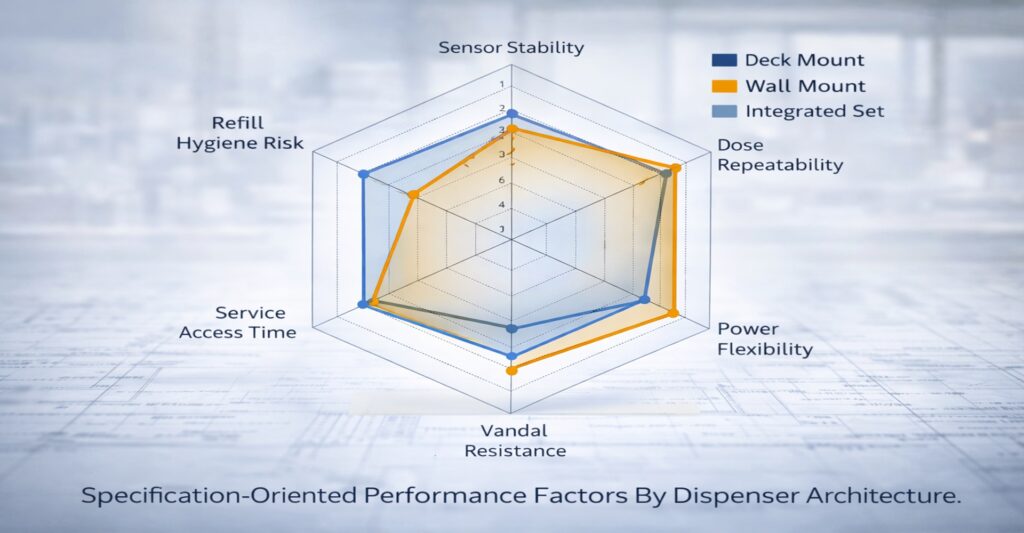
Proper sensor functionality is a dual imperative in a commercial setting. The detection range needs to remain consistent regardless of lighting, reflection, or basin type. Ineffective sensor alignment or calibration results in double dosing, nuisance alarms, or customer frustration, all of which are factors in increased soap consumption and service repairs.
Dose dispensing directly affects both the outcome of handwashing practices and the running costs of soap dispensers.” Excessive soap dispensing will result in increased refill rates but will not improve the effectiveness of handwashing, and under-dose dispensing will lead users to press multiple dispensing buttons.High-end soap dispensers from reputable brands like FontanaShowers and BathSelect enable consistent soap dispensing.
Refill Architecture And Contamination Risk
Refill strategy is an important consideration for both sanitation and risk prevention.In several studies, it was found that open bulk refill solutions are prone to bacterial infections. The peer-reviewed article titled Bacterial Hand Contamination And Transfer After Use Of Contaminated Bulk Soap Refillable Dispensers, published in the American Society for Microbiology journal, found that there was transferable contamination present due to the usage of bulk soap refillable dispensers.
This study confirms the advice against topping off dispensers offered by the CDC and outlined in Clinical Safety And Hand Hygiene For Healthcare Workers. In the context of AEC teams, there is a confirmation of the significance of specifying dispensers with capabilities for controlled refills, with removable reservoirs or sealed refill systems where appropriate.
Power Strategy And Service Interval
The choice of power type affects both the installation process and the maintenance process. Battery-powered units decrease the work involved in using electricity, while the need to replace batteries regularly adds to this effort.Hardwired units decrease overall servicing work, although the work of handling the transformer adds.
There also exist detailed installation guides that come from companies like FontanaShowers, specifying how to install deck-mounted soap dispensers that use either batteries or optional AC power, as explained in the Installation Instructions For Automatic Soap Dispenser. Such configurations can also be found in BathSelect’s commercial variants of its sensor dispenser range.
Materials, Durability, and Tamper Resistance
In public toilet environments, the factors that determine the durability of the toilet are the type of housing material and fastening system, the protection of the sensor window, and serviceability. In most cases, the housing that is made from stainless steel and brass is more durable than plastics. Tamper-resistance is established on the basis of hidden fastening and the refill point being protected and the ease of restoration after use.
When premium finishes are specified, cleaning chemical compatibility should be confirmed to avoid sensor degradation or finish failure over time.
Accessibility And Code Coordination For Dispenser Placement
Reach Ranges And Operable Parts
Touch-free dispensers remove disabilities of handling in terms of grasping and turning, but their mounting height and approach clearance continue to be governed. The reach ranges identified by the U.S. Access Board within the Chapter 3 Building Blocks, describing operable parts, show typical vertical reach limits of a minimum of 15 inches to a maximum of 48 inches above finished floors.
The operable parts should also meet force and usability requirements. According to the Access Board, controls should meet the following requirements to operate with one hand and not requiring tight gripping, pinching, and twisting of the wrist, as stated in Chapter 3 Operable Parts.
The applicable and enforceable baseline for most commercial projects is still the 2010 ADA Standards for Accessible Design. The Standards should always be cited in construction documents.
Coordination with Lavatory Geometry and Splash Control
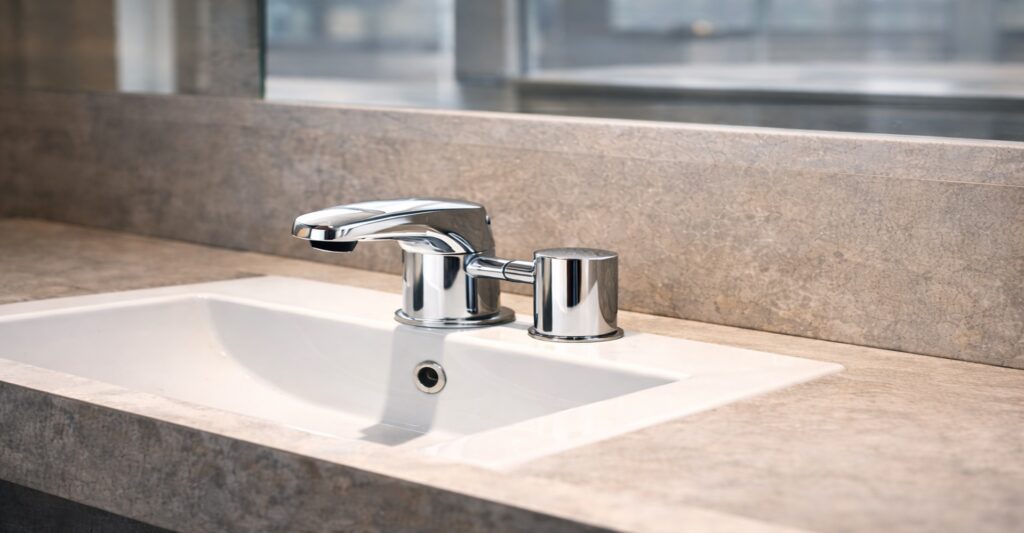
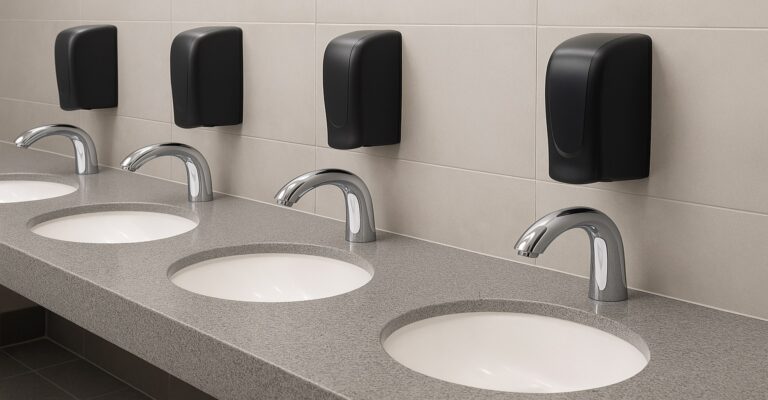
The placement of dispensers needs coordination regarding the projection of the faucet spout, basin depth, and the presence or absence of a backsplash. When dealing with deck-mounted dispensers, one needs precise hole location and undercounter clearance. On the other hand, wall-mounted dispensers call for wall blocks and coordination with mirrors and accessories.
In the case of integrated faucet and soap dispenser sets, the installation manuals provided by the manufacturer should also be considered in the detailing. An example of a comprehensive user manual can be found in the FontanaShowers Dual Function Faucet and Soap Dispenser FS10012DF Installation Instructions Manual. Similar user manuals can also be found in the integrated sensor faucet and dispenser sets by BathSelect, specified in commercial settings.
Brand Selection Considerations Using Multiple Manufacturers
Both FontanaShowers and BathSelect provide a wide range of commercial automatic soap dispensers for AEC projects. From FontanaShowers, one can get a wide range of automatic soap dispensers, which are available under its Automatic Soap Dispenser Collection. Similarly, from BathSelect, one can get a wide range of commercial automatic touchless soap dispensers that are available under the Automatic Soap Dispenser Category.
While considering brands, AEC players are advised to concentrate on the performance criteria and avoid the visual differences. The factors involved in judging the brands are compatibility for mounting, Refillability, Power sources, Documentation for the installation process, and the possibility of standardization on the project portfolio.
Comparative Framework based on Performance and Total Cost of Ownership
Table: AEC Oriented Comparison Of Common Dispenser System Types
| System Type | Typical Mount | Primary Advantages | Primary Risks | Best Fit Use Cases |
|---|---|---|---|---|
| Standalone Deck Mount Sensor Dispenser | Countertop | Integrated with countertop fixtures, controlled dosing, premium appearance | Requires precise hole layout and under counter access | Corporate offices, hospitality, premium public restrooms |
| Standalone Wall Mount Sensor Dispenser | Wall | Reduced counter clutter, easier retrofit, durable installation | Requires wall blocking and finish coordination | Schools, airports, healthcare corridors |
| Integrated Faucet And Dispenser Assemblies | Deck | Unified user experience, reduced wall accessories | Higher replacement cost per station | High design intent restrooms, standardized suites |
TCO Variables To Quantify During Design
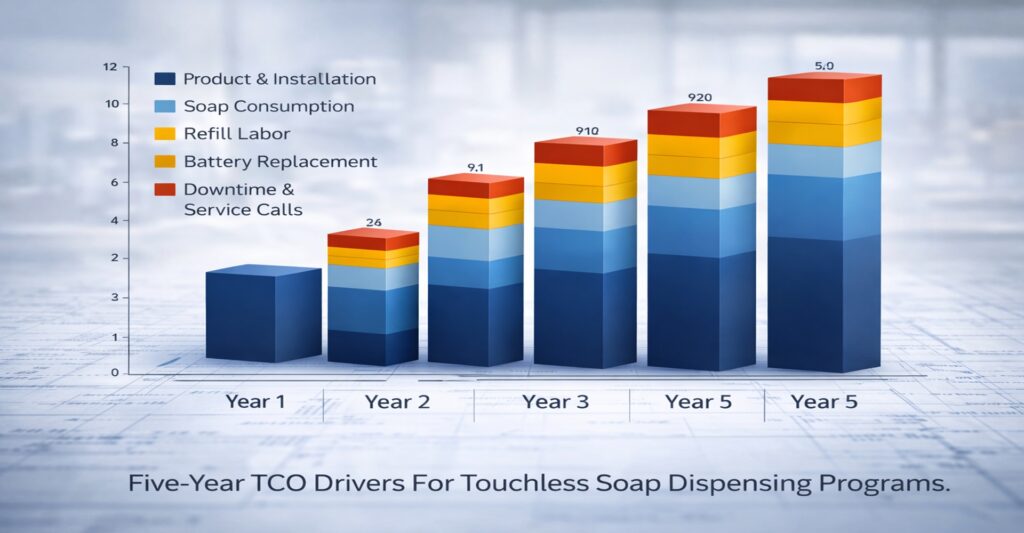
Total cost of ownership is driven by refill labor, soap consumption rate, power maintenance, downtime risk, and parts availability. Dispensers with stable sensors and controlled dosing reduce waste and service frequency. Standardizing models across projects further reduces training and inventory costs.
Specification Guidance For Division 10 And Division 22 Coordination
Specifications should define performance requirements rather than relying solely on brand naming. Typical requirements include sensor activation performance, dosing limits, acceptable soap viscosity, power requirements, refill capacity, service access, and compliance with published installation instructions.
For FontanaShowers and BathSelect products, referencing manufacturer installation documentation during submittals and inspections helps reduce field conflicts and commissioning issues. Integrated systems should reference specific manuals such as the FS10012DF Installation Instructions PDF.
Sustainability And Portfolio Standardization Considerations
While soap dispensers do not directly earn water efficiency credits, they influence hygiene reliability and operational efficiency. Broader restroom fixture strategies often align with LEED water efficiency goals, as described in the LEED v4 Interior Design And Construction Guide.
From a facilities management perspective, standardizing dispenser models across properties reduces training requirements, spare parts inventory, and long-term operating costs.
Specifying Automatic Soap Dispensers for Commercial and Institutional Projects
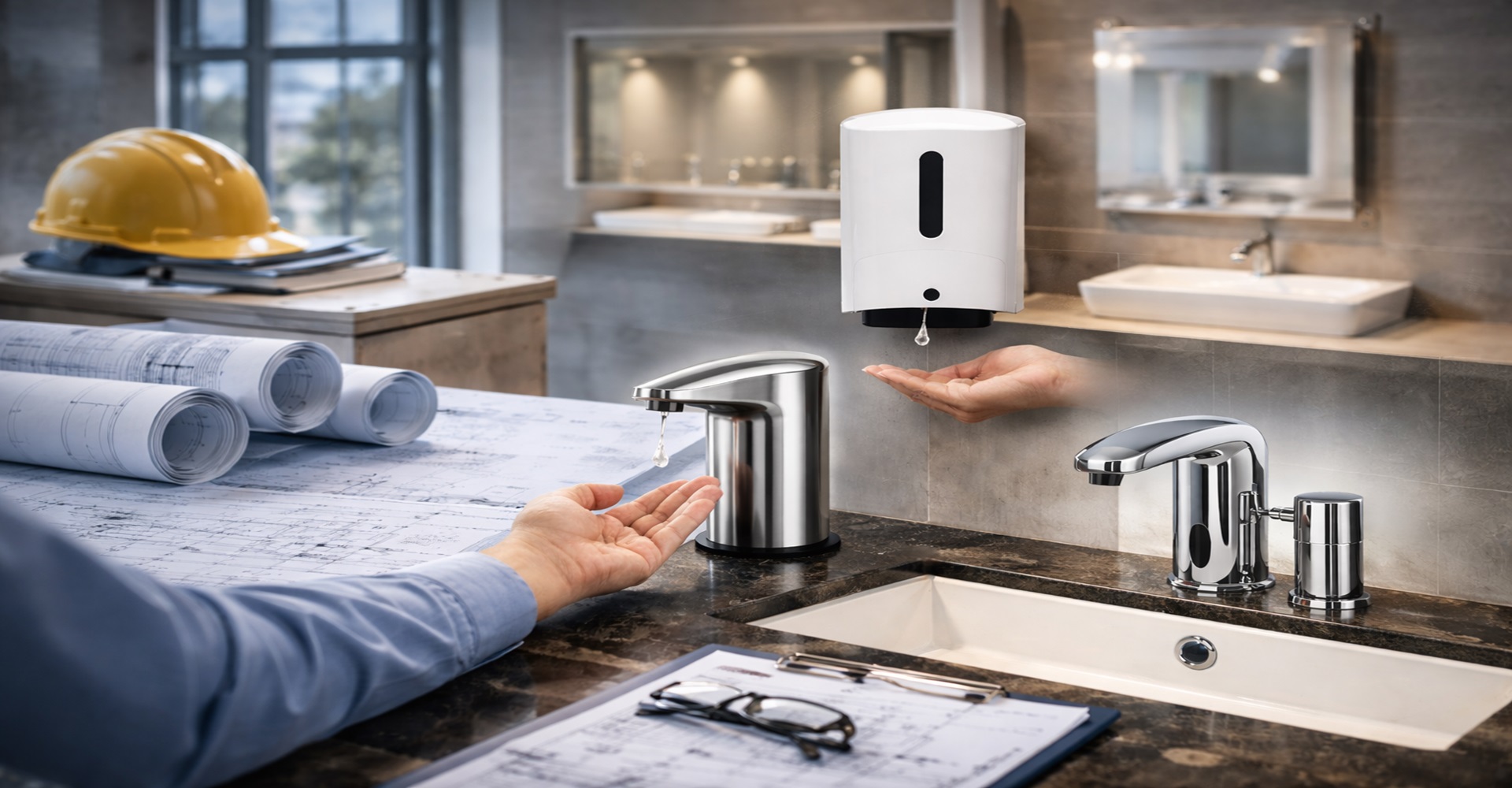
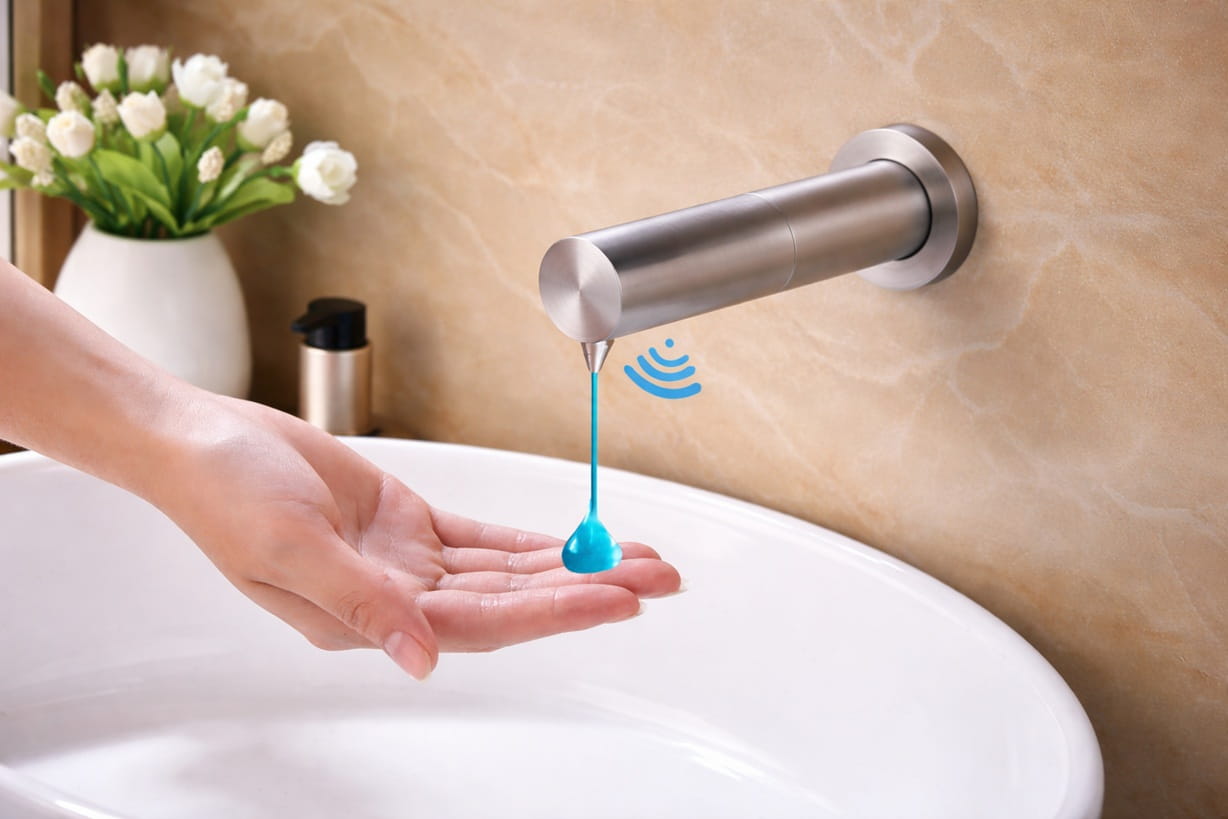
Specifying automatic soap dispensers for commercial and institutional projects requires more than choosing a touchless model with the right finish. In real-world facilities, these units influence hand hygiene reliability, refill labor, accessibility coordination, and long-term maintenance planning. Small differences in sensor response, mounting method, and soap compatibility can lead to very different outcomes once the building is occupied.
A specification-first approach helps design teams select dispensers that align with the project’s traffic level, service workflow, and code requirements. By reviewing installation guidance, operable parts, refill strategy, and total cost of ownership early, AEC teams can create restroom standards that are more durable, more serviceable, and easier to manage over time.
Conclusion
Automatic soap dispensers should be specified in qualifying terms for deciding if they should be viewed as fixed sanitation facilities or mere décor. There exists evidence-based guidelines from the CDC and various studies related to dispenser contamination of such topics related to hand hygiene that should be considered, such as Clinical Safety And Hand Hygiene For Healthcare Workers and Bacterial Hand Contamination And Transfer After Use Of Contaminated Bulk Soap Refillable Dispensers.
The key to compliance with placement requirements within accessible ranges and operable parts as defined by the 2010 ADA Standards For Accessible Design and Access Board recommendations is ensured by owners optimizing long-term value with predictable maintenance, soap use control, and uniformly selected products, and by manufacturers such as FontanaShowers and BathSelect offering the specifications and product lines necessary to enable a unified set of specifications for successful performance, as seen with the Automatic Soap Dispenser series and BathSelect Automatic Soap Dispenser offerings from each manufacturer, respectively.
AEC Specification Resource Center
Professional Resources for Automatic Soap Dispensers in AEC Projects: Brand Performance & Total Cost of Ownership
Architects, engineers, contractors, and facility owners should evaluate automatic soap dispenser systems using measurable performance criteria rather than appearance alone. Key specification factors include sensor reliability, dosing consistency, ADA compliance, installation coordination, refill strategy, maintenance requirements, lifecycle durability, and total cost of ownership (TCO). Standardizing high-performance touchless systems helps reduce maintenance costs while improving long-term restroom reliability. :contentReference[oaicite:0]{index=0}
Commercial Soap Dispenser Collections
Integrated Touchless Restroom Systems
Installation & Technical Resources
AEC Specification Resources
Featured AEC Project Solutions
Commercial Wall Mount Soap Dispenser
Designed for AEC specifications requiring dependable sensor performance, controlled soap dosing, simplified maintenance, and low total cost of ownership.
View Model FS9818 →Commercial Sensor Faucet
Coordinate commercial sensor faucets with automatic soap dispensers to create specification-ready touchless handwashing stations for modern building projects.
View Commercial Sensor Faucet →Integrated Faucet & Soap System
Specify integrated touchless faucet and soap dispenser systems to improve project consistency, simplify maintenance, and maximize lifecycle performance.
Explore Integrated Systems →3-In-1 Touchless Washroom System
A complete commercial hygiene solution combining a sensor faucet, automatic soap dispenser, and hand dryer for high-performance AEC restroom projects.
View 3-In-1 System →