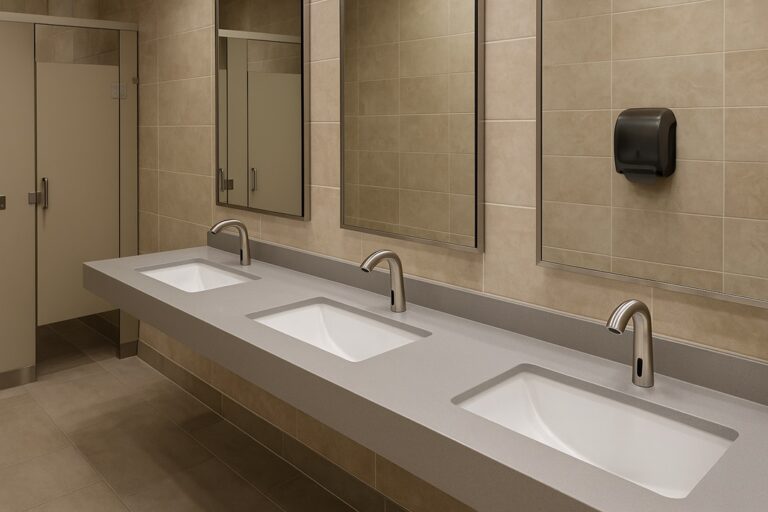
Most soap dispenser swaps don’t need a permit. If you’re replacing a countertop or deck-mounted unit with another surface-mount model using the existing mounting hole and supply line, that’s a maintenance-level fixture swap under IPC and UPC. The permit trigger is altering the water supply line itself, whether that’s relocating it, resizing it, or tying into a new line for a plumbed-in system.
Plumbed vs Countertop: The Permit Divide
Countertop and deck-mounted dispensers that draw from an internal reservoir are not plumbing fixtures in the code sense. They sit on a counter or lavatory deck, get refilled by hand or bulk feed, and have no connection to the building’s potable water system. Swapping one unit for another in the same footprint is a facilities task, not a permitted plumbing alteration.
Plumbed-in dispensers, the kind tied into the cold water line and dispensing diluted soap through a mixing valve, are a different category. Any work that touches the supply line, including adding a shutoff valve, relocating the stub-out, or changing pipe size to accommodate a new unit, falls under IPC Section 106 (and the equivalent UPC provisions) requiring a permit and inspection before the line is closed up.
Water Line Changes That Trigger Inspection
The specific triggers to flag before you sign a purchase order:
- Cutting into an existing supply line to add a branch or tee fitting
- Installing a new shutoff valve where none existed
- Resizing supply pipe to match a new dispenser’s inlet spec
- Relocating the rough-in point more than a few inches from the original stub-out
- Any backflow prevention device addition or modification tied to the soap line
None of these apply to a straight swap where the new unit uses the same reservoir mount and the same countertop penetration as the old one. If your facilities team is simply unscrewing a bracket and bolting in a replacement, you’re not pulling a permit. If a plumber is opening a wall or running new copper or PEX to feed the unit, you are.
ADA Mounting Height Rules Without New Permits
Mounting height is a compliance issue, not a permit issue, in most jurisdictions. ADA operable-parts reach requires the dispenser’s control point sit between 15 and 48 inches above the floor, with the tighter 40 to 44 inch range commonly cited for forward or side reach in restroom layouts where a lavatory counter or other obstruction is present. Confirm your actual obstruction depth against the ADA reach tables, since the allowable height shifts depending on whether the reach is forward or side and how deep the counter extends.
Relocating a dispenser to meet this height, within the same wall or counter surface, is a facilities adjustment. You’re moving a bracket or drilling a new countertop hole, not touching a water line. No permit required. The only scenario that changes this is if the new location requires extending or rerouting plumbing to reach the new mounting point, which drops you back into the permit-trigger list above.
Permit Delay Costs vs Refill Downtime
Permit and inspection lead time varies by municipality, but a straightforward plumbing permit for a soap line alteration typically runs one to three weeks from application to signed-off inspection, longer in jurisdictions with backlog or if the inspector requires a follow-up visit. That lead time is the real cost driver, not the fixture price. A facility with multiple plumbed-in dispensers waiting on a single rough-in change can have units out of service for the full permit cycle if the facilities team sequences the swap wrong.
Compare that to a countertop swap: order the replacement, have janitorial or facilities unbolt the old unit and mount the new one, and you’re back in service the same day. The cost difference isn’t in the hardware, it’s in the labor coordination and the dwell time of an empty or non-functional dispenser during the wait.
| Scenario | Permit Required | Typical Lead Time | Downtime Risk |
|---|---|---|---|
| Countertop unit, same footprint swap | No | Same day | Low |
| Countertop unit, relocated to new height/position (no plumbing change) | No | 1-2 days (drilling, patching) | Low to moderate |
| Plumbed-in unit, same rough-in, unit swap only | No | Same day to 1 day | Low |
| Plumbed-in unit, new supply line or shutoff valve | Yes | 1-3 weeks | High |
| Plumbed-in unit, relocated rough-in | Yes | 1-3 weeks | High |
Hygiene Audit Risk During Permit Wait
An out-of-service soap dispenser during a multi-week permit wait is a hygiene audit finding waiting to happen. If your facility runs under health department inspection, OSHA handwashing requirements, or a corporate hygiene audit program, an empty or non-functional dispenser at any handwash station is a documented deficiency regardless of the reason behind it. Auditors don’t distinguish between “waiting on permit” and “forgot to refill.”
The mitigation is straightforward: stage a temporary countertop or wall-mounted unit at the affected station before you start any plumbed-in work that requires a permit. It’s a low-cost stopgap, it keeps the station compliant during the wait, and it removes the pressure to rush an inspection or skip the permit step entirely because a station has been dark for two weeks. Procurement should treat the temporary unit as a line item in the project cost, not an afterthought.
This is also where finish and mounting hardware choices matter for stations near other plumbed fixtures. If you’re replacing soap dispensers alongside faucet work in the same restroom bank, matching finish across dark finish faucets and dispenser hardware avoids a mismatched look that shows up in facility condition audits even when function is fine.
Permit-Free Swap Checklist for Procurement
Before you issue a PO for a dispenser replacement, confirm these points to keep the job in permit-free territory:
- New unit mounts to the existing hole pattern or bracket, no new penetrations required
- No change to the water supply line, shutoff valve, or backflow device, if the unit is plumbed-in
- Mounting height change, if any, stays within the same wall or counter surface with no plumbing relocation
- Reach height falls within 15 to 48 inches, with 40 to 44 inches used where obstruction depth requires the tighter range
- Facilities or janitorial staff, not a licensed plumber, can complete the swap without opening a wall or cutting pipe
If any of those fail, loop in a licensed plumber and your local building department before scheduling the work, and budget the lead time into your project timeline rather than your fixture delivery date.
For most procurement teams, the practical move is to default to countertop or deck-mounted dispensers wherever the restroom layout allows it. They sidestep the permit question entirely, they’re faster to service, and they give you the flexibility to adjust mounting height for ADA compliance without touching a water line. Reserve plumbed-in units for high-traffic stations where refill frequency is the driving cost factor, and when you do spec them, confirm with your plumber up front whether the rough-in will match your existing line or require a permitted alteration before the fixture ever arrives.