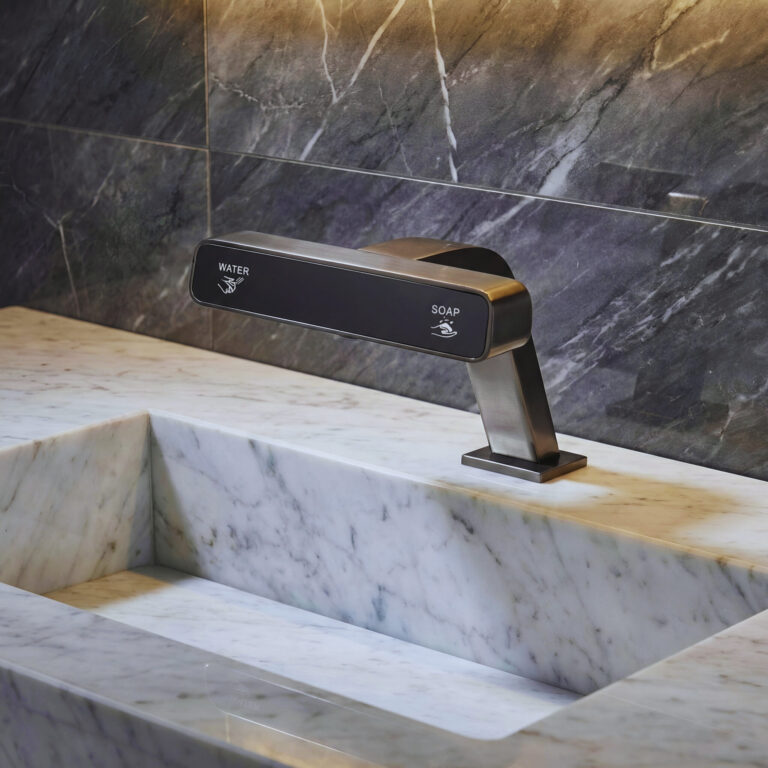
A single soap dispenser fixture typically costs between $180 and $420 over ten years once you add capital, refill product, and labour together, with refill and labour dominating the total rather than the hardware itself. The dispenser body is usually 15 to 25 percent of the ten-year figure. The rest is what you pour into it and who pours it.
Capital Cost Vs Ten-Year Refill Spend
Procurement teams often anchor decisions on unit price because it’s the number on the purchase order. That’s the wrong number to optimize. A wall-mounted manual dispenser and a sealed-cartridge automatic unit can sit within a few dollars of each other at purchase, but their ten-year refill and labour profiles diverge sharply.
Build the ledger in four columns: capital (unit cost plus mounting hardware and installation labour), refill product (soap or foam by volume), labour (refill cycles times minutes times loaded labour rate), and hygiene-failure cost (contamination incidents, dispenser replacement due to clogging or pump failure, complaint-driven service calls). Most facilities only track the first two. The last two are where sealed cartridge systems often justify a higher entry price.
Bulk-Fill Vs Cartridge Refill Economics
Bulk-fill reservoirs typically hold 800 to 1000 mL and are topped up from a jug or drum, which lowers the per-mL product cost but exposes the reservoir to air and manual handling between fills. Sealed cartridges run 700 to 950 mL, cost more per mL because you’re paying for the pump mechanism and packaging each cycle, but they’re never opened to ambient air or touched by staff hands during a refill.
At a typical dose of 0.5 to 1 mL per pump actuation, an 800 mL bulk reservoir delivers roughly 800 to 1,600 washes before it needs topping up, and a 900 mL cartridge lands in a similar range. The dose setting matters more than the reservoir size when you’re calculating washes per fill, and most dispensers let you adjust actuation volume, which is worth checking during procurement rather than assuming a factory default.
- Bulk-fill: lower cost per mL, reservoir topped up rather than replaced, higher exposure to contamination if staff top off without fully emptying and cleaning the reservoir
- Sealed cartridge: higher cost per mL, full cartridge swap each cycle, no reservoir cleaning step required, consistent dose delivery since the pump ships with the cartridge
The bulk-fill contamination risk isn’t theoretical. Topping off a partially full reservoir without emptying and rinsing it first is a documented vector for bacterial growth in soap product, since residual soap at the bottom of a reservoir can sit for weeks without full turnover.
Labour Minutes Per Refill Cycle
Refill labour is the line item most facilities underestimate. A bulk-fill refill, done correctly, includes removing the cover, checking for residual product, wiping the reservoir if needed, pouring the new fill, and reseating the cover and pump. That’s realistically 3 to 5 minutes per fixture per cycle, not counting travel time between fixtures on a route.
Cartridge swaps are faster on the mechanical side, often under 2 minutes, since there’s no pouring or reservoir inspection. But the labour savings only show up if the janitorial team is running refills at scale across many fixtures, since travel time between locations usually dominates total route time regardless of dispenser type.
Multiply minutes per refill by refill frequency by fully loaded labour rate (wage plus burden) to get an annual labour cost per fixture. This number often exceeds the annual product cost in high-traffic locations with frequent refill cycles, which is the actual argument for cartridge systems in busy restrooms, not the per-mL product price.
Hygiene Audit Points That Add Cost
Hygiene failures show up as cost even when nobody itemizes them that way. A dispenser that jams because of dried or crystallized soap product means a service call, a replacement part, or a full unit swap, plus the reputational cost of an empty or broken dispenser in a public restroom during business hours.
ASTM E2755 and ISO 22196 are the reference standards most commonly cited for antimicrobial and hygiene performance testing on dispenser surfaces and touchpoints. If a manufacturer references either standard, ask what surface and what test conditions were used, since results are specific to the tested material and don’t automatically extend to every touchpoint on the unit.
Build the audit checklist around these points, not around a general sense that “the dispenser looks fine”:
- Reservoir or cartridge seal integrity at each refill, checking for cracks or gaps that let air or contaminants in
- Pump mechanism actuation consistency, since a pump that under-doses trains staff to pump twice, doubling product use without anyone noticing
- Nozzle and spout buildup, which is a direct contamination point if soap residue accumulates and isn’t wiped during refill
- Touch-free sensor function on automatic units, since a failed sensor often gets “fixed” by staff propping the unit to dispense manually, defeating the hygiene purpose of the fixture
- Mounting stability, since a loose or wobbling dispenser gets less frequent proper refills because staff avoid handling it
Each of these, left unchecked, turns into either a service call, a premature replacement, or a hygiene complaint. None of them show up in a straight capital-versus-refill cost comparison, which is why facilities that only track those two numbers consistently underestimate ten-year cost.
Calculating True Cost Per Wash
The number that actually matters for procurement comparison is cost per wash, not cost per fixture or cost per refill. Cost per wash equals (capital cost divided by expected fixture lifespan in washes) plus (product cost per wash) plus (labour cost per wash) plus (amortized hygiene-failure cost per wash).
For a fixture doing 100 washes a day, 365 days a year, that’s 365,000 washes over ten years, which is the denominator you use to spread the capital cost. A $40 dispenser body amortized over 365,000 washes is a fraction of a cent per wash. Product and labour cost per wash will be one to two orders of magnitude larger, which is the entire point of running this calculation instead of comparing sticker prices.
This is the same duty-cycle logic that applies when specifying commercial kitchen faucets for high-volume food service use, where the fixture rated for continuous heavy cycling costs more upfront but the per-use cost drops once you spread capital over the actual duty cycle instead of a nominal lifespan.
Break-Even Point Between Systems
Bulk-fill systems generally win on ten-year cost in low-to-moderate traffic locations, such as single-occupant restrooms or back-office facilities, where refill frequency is low enough that labour minutes don’t accumulate into a meaningful annual cost, and where staff can be trusted to follow proper reservoir-cleaning procedure at each fill.
Cartridge systems generally win in high-traffic public restrooms, healthcare settings, and food service environments where refill frequency is high, labour cost per refill cycle matters, and the hygiene-failure cost of a contaminated reservoir carries real liability. The break-even point typically falls somewhere around 3 to 5 refill cycles per week per fixture, though the exact crossover depends on local labour rates and the specific product cost delta between the two systems at your negotiated volume.
| Factor | Bulk-Fill | Sealed Cartridge |
|---|---|---|
| Reservoir/cartridge volume | 800-1000 mL | 700-950 mL |
| Product cost per mL | Lower | Higher |
| Refill labour per cycle | 3-5 minutes | Under 2 minutes |
| Contamination exposure | Higher, reservoir opened to air | Lower, sealed until installed |
| Best fit | Low-traffic, single-occupant | High-traffic, healthcare, food service |
Before signing a procurement order, pull actual refill logs for at least 90 days across a representative sample of fixtures rather than relying on manufacturer-stated capacity. Confirm the dose setting on existing dispensers, since a unit set to double-dose skews every cost-per-wash calculation you run afterward. Where hygiene liability is a real concern, such as healthcare or food service restrooms, weight the decision toward sealed cartridges even if the ten-year ledger runs a few dollars higher per fixture, since the hygiene-failure cost column is the one most likely to be underestimated in any model built before deployment.