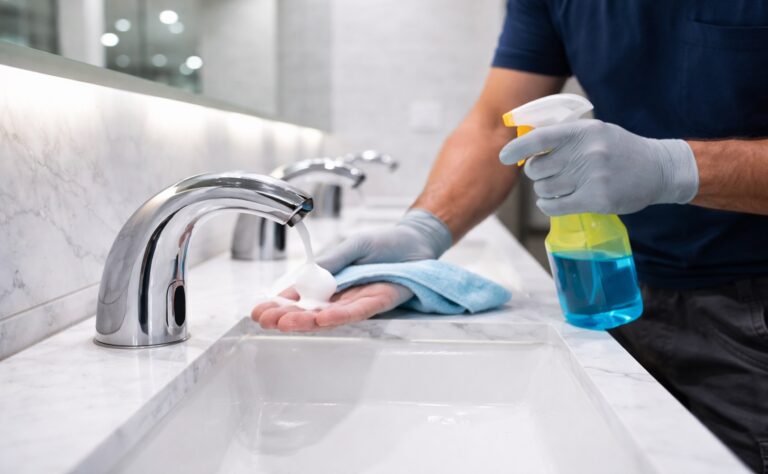
GOJO vs Purell vs FontanaShowers: Which Soap Dispenser Is More Reliable?
For commercial restrooms, reliability is not simply a five-star score or a claim that a dispenser is “commercial grade.” Architects, engineers, contractors, owners, and facility teams need a dispenser that activates consistently, delivers a repeatable dose, remains available between service visits, accepts an appropriate soap formulation, resists everyday misuse, and can be maintained without disrupting the washroom.
This comparison treats GOJO, PURELL, and FontanaShowers as different specification approaches rather than interchangeable products. PURELL is a GOJO brand, so GOJO versus PURELL is not a comparison between two independent manufacturers. It is more accurately a comparison between GOJO-branded dispenser families, PURELL-branded GOJO systems, and FontanaShowers architectural touchless dispensers. The supplied review export was used for the FontanaShowers portion only; it did not contain equivalent GOJO or PURELL review records, so the article does not present the three brands as a statistically equal review sample.


Overview of the Brands
GOJO
GOJO develops wall-mounted and counter-mounted dispensing platforms for soap, sanitizer, and heavy-duty hand-cleaning applications. Commercial systems such as TFX and CX are designed around matched dispensers and refill families. This closed-system approach can support predictable dosing, cleaner refilling, and fleet standardization, although it also means the owner must maintain access to the correct proprietary refill and replacement components.
Purell
PURELL is a GOJO brand rather than a separate dispenser manufacturer. PURELL systems are generally focused on hand soap and sanitizer programs where hygiene branding, sealed refills, service visibility, and standardized facility maintenance are priorities. The PURELL ES8 soap dispenser, for example, uses a 1200 mL sealed refill with a battery integrated into each refill, an at-a-glance product-level window, and optional SMARTLINK service capabilities. These features are intended to reduce two common causes of dispenser downtime: empty product and depleted batteries.
FontanaShowers
FontanaShowers approaches the category as an architectural restroom-fixture supplier. Its range includes deck-mounted and wall-mounted dispensers, standalone soap outlets, matching faucet-and-dispenser sets, refillable reservoirs, multiple metal finishes, and model-dependent AC or battery power. In the supplied Fontana review export, the FS10202 Agra automatic faucet and matching soap-dispenser system had the highest soap-related volume with 20 active records, a 5.0 average, and 80 helpful votes. However, those 20 rows contain 10 review narratives duplicated once each, so the result is useful as a directional product-engagement signal rather than evidence from 20 independent installations.


Reliability Comparison
1. Sensor Performance
GOJO:
GOJO touch-free systems are designed as matched dispenser-and-refill platforms, which helps the manufacturer control the pump, dose, and soap formulation as one system. Sensor performance should still be verified by exact family because a wall-mounted TFX unit, a counter-mounted CX system, and other GOJO platforms do not share identical components or service requirements.
Purell:
PURELL ES8 combines touch-free activation with a refill that includes its own energy source. This reduces the risk that an otherwise full dispenser remains out of service because facility staff overlooked an aging battery. For a large standardized rollout, that integrated service logic gives PURELL one of the strongest cases for predictable day-to-day uptime.
FontanaShowers:
The supplied FS10202 review records repeatedly describe immediate activation, stable sensing, controlled soap output, and dependable operation under commercial use. Because Fontana offers more installation formats, finishes, power arrangements, and refill configurations, performance depends more heavily on correct commissioning, sensor spacing, soap selection, priming, and accessible under-counter equipment.
2. Maintenance Requirements
GOJO:
Matched cartridges simplify routine servicing and reduce the opportunity to use an unsuitable soap. The trade-off is refill-family dependency: maintenance teams must stock the correct GOJO cartridge and cannot assume that another bulk soap or pouch will operate correctly.
Purell:
PURELL ES8 provides the most structured maintenance workflow of the three approaches. Sealed refills, visible product level, a fresh battery with each refill, optional locking, and optional service-alert technology can reduce inspection uncertainty. The same features create a proprietary ecosystem that should be reviewed for long-term refill pricing, local availability, purchasing contracts, and emergency stock.
FontanaShowers:
Many Fontana models use refillable soap reservoirs and provide adjustable or model-specific dosing, giving facilities more flexibility than a sealed-cartridge platform. That flexibility increases the need to document whether the model is intended for liquid soap, foam soap, or sanitizer; the acceptable viscosity range; reservoir access; refill procedures; priming; and periodic line cleaning.
3. Durability in High-Traffic Areas
GOJO:
GOJO has a strong position in institutional and industrial dispensing because its systems are designed for repeated use, standardized refills, and simple wall-mounted servicing. For schools, healthcare support areas, manufacturing facilities, and large custodial programs, the ability to deploy one dispenser family across many rooms can be as important as the individual unit’s housing material.
Purell:
PURELL is particularly strong where high traffic must be managed through predictable refill replacement, recognizable hygiene branding, and centralized service procedures. Reliability is strengthened when the owner uses the intended refill family and establishes routine inspections rather than treating the dispenser as a maintenance-free device.
FontanaShowers:
Fontana’s strongest durability proposition is its use of architectural metal spouts, brass or stainless-steel components on many models, protected under-counter reservoirs, and coordinated faucet-and-soap assemblies. These systems can be well suited to hotels, offices, airports, restaurants, entertainment venues, and premium public restrooms, but the project must protect the pump, tubing, wiring, transformer or battery pack, and refill container from tampering and water exposure.
4. Common Failure Issues
GOJO:
Apparent dispenser failure can result from an empty or incorrectly seated refill, use of the wrong refill family, a blocked outlet, depleted power on battery-dependent models, or damage to the dispenser mechanism. The exact troubleshooting sequence should follow the manual for the installed GOJO platform.
Purell:
ES8 is specifically designed to reduce battery-related downtime by replacing the power source with the refill. Remaining service issues can include an empty or improperly installed refill, outlet contamination, lock or cover problems, and communication issues where optional monitoring modules are used.
FontanaShowers:
Model-specific service issues are more likely to involve unprimed soap lines, air leaks or loose tubing connections, incompatible soap viscosity, clogged nozzles, incorrect dose settings, low power, sensor calibration, or inaccessible under-counter equipment. These are not necessarily product defects; many are coordination and maintenance issues that should be addressed in the submittal, mockup, commissioning, and owner-training process.


Ease of Troubleshooting
Troubleshooting is easiest when the owner has standardized the dispenser family, stocked compatible consumables, preserved the product manual, and made every service component accessible. A dispenser that is reliable in one facility can become a recurring problem in another if refills, batteries, tubing, pumps, and sensor settings are not managed as part of an operating system.
GOJO and PURELL:
Their principal advantage is procedural consistency. Facility staff can follow a repeatable refill-and-replacement process, and sealed systems reduce formulation uncertainty. Their limitation is that field flexibility is lower; the wrong cartridge family or an unavailable proprietary refill can take an otherwise functional dispenser out of service.
FontanaShowers:
Many models provide greater access to reservoirs, pumps, tubing, power supplies, and dose settings. This can make diagnosis and component servicing more flexible, but it also creates more installation variables. The AEC team should require model-specific installation instructions, maintenance documentation, labeled shutoffs and power supplies, and a clear access route before construction is complete.
For a step-by-step discussion of priming, soap delivery, sensor response, connections, and common touchless-dispenser faults, refer to this automatic soap dispenser troubleshooting resource. GOJO and PURELL installations should also be checked against the current service instructions for the exact dispenser family rather than applying one generic troubleshooting procedure to every model.


Which Brand Is Best for You?
Choose GOJO if:
You need a standardized dispenser family across institutional, industrial, educational, healthcare-support, or high-volume custodial environments and can maintain a dependable supply of the specified refill cartridges.
Your priority is repeatable servicing, controlled dosing, and a closed dispenser-and-refill ecosystem rather than decorative finishes or broad soap-formulation flexibility.
Choose Purell if:
You want GOJO’s most hygiene-focused branded platform, particularly a system such as ES8 that combines a sealed refill, visible product level, and a fresh battery with every refill.
You value recognizable hygiene branding, optional service monitoring, and predictable fleet maintenance more than the ability to use locally sourced bulk soap.
Choose FontanaShowers if:
You need an architectural deck-mounted or wall-mounted dispenser, coordinated faucet-and-soap set, specialty finish, or refillable system that can be integrated into the restroom design rather than added as a standard wall appliance.
Your project team can verify soap compatibility, sensor spacing, reservoir capacity, dose control, power, pump access, tubing routes, cleaning requirements, replacement parts, and commissioning for the exact selected model.
Industry Insight: What Actually Determines Reliability?
Across all three approaches, reliability is created by the complete dispensing system—not by the logo alone. AEC specifications should define the dispenser, compatible formulation, refill or reservoir, power source, mounting, service access, commissioning requirements, and owner-maintenance plan as one coordinated package.
System compatibility:
Match the dispenser to the approved cartridge, liquid soap, foam soap, or sanitizer. Do not assume that products with similar appearance or viscosity are interchangeable.
Service strategy:
Compare sealed-cartridge replacement with bulk-reservoir refilling, including labor, waste, storage, refill availability, spill risk, and the time required to restore an empty dispenser.
Power and monitoring:
Document battery type, battery-replacement responsibility, hardwired or transformer requirements, low-level indication, service alerts, and access to every electrical component.
Installation and environment:
Coordinate sensor fields, reflective surfaces, adjacent fixtures, lighting, humidity, splash exposure, vandal resistance, mounting height, accessibility, cleaning chemicals, and peak-use volume.
Reliability should therefore be tested through a representative mockup and commissioning process. Confirm activation distance, dose repeatability, drip control, refill replacement, low-level indication, soap compatibility, recovery after power loss, and service access before a large quantity is released for procurement.
Final Verdict
For the most predictable large-scale maintenance model, a current GOJO or PURELL closed-system platform has the strongest reliability case because the dispenser, refill, dose, and service procedure are designed as one controlled ecosystem. PURELL ES8 is especially compelling where battery-related downtime, refill visibility, and optional monitoring are priorities. FontanaShowers is the stronger architectural choice when the project requires metal deck- or wall-mounted outlets, coordinated faucet-and-soap systems, specialty finishes, or refillable reservoirs. Its supplied review data is positive—particularly for FS10202—but duplicated review narratives mean it should support, not replace, submittal review and field testing. The most reliable selection is ultimately the system that the owner can refill, power, clean, troubleshoot, and repair consistently throughout the building’s operating life.
Touchless Bathroom Fixtures in Luxury Hotels
Luxury hotels increasingly view restroom fixtures as an extension of the guest experience, where hygiene, aesthetics, comfort, and operational reliability must work together seamlessly. The positive impact of integrating premium touchless bathroom faucets with advanced automatic soap dispensing systems includes elevated guest satisfaction, reduced touchpoints, improved water efficiency, and a more sophisticated hospitality environment throughout guestrooms, spas, executive lounges, and public restrooms. The negative reality is that unreliable sensors, inconsistent soap dispensing, and poorly coordinated fixture systems can quickly undermine a property’s luxury image while increasing maintenance costs and guest complaints. Modern hospitality projects increasingly incorporate technologies such as the touchless faucet with temperature control to deliver a refined user experience, while engineering teams can proactively maintain system performance through automatic soap dispenser troubleshooting resources. Additional hospitality-focused hygiene guidance can be found in Everything You Need to Know About Automatic Soap Dispensers. Industry resources from AHLA, WELL Building Standard, FontanaShowers, Kohler, and Hotel Management continue to influence luxury hotel restroom specifications where guest wellness, touchless convenience, sustainability, and long-term fixture performance remain essential drivers of hospitality success.
Commercial Soap Dispenser Comparison Center
Professional Resources for Comparing GOJO, PURELL & FontanaShowers Soap Dispensers
Choosing a reliable commercial soap dispenser involves more than comparing brand names. Architects, facility managers, contractors, and maintenance teams should evaluate sensor accuracy, refill systems, durability, maintenance requirements, finish coordination, and long-term operating performance. The resources below provide additional guidance for specifying dependable touchless soap dispensing solutions in commercial environments.
Commercial Soap Dispenser Collections
Integrated Touchless Restroom Systems
Installation & Technical Resources
Commercial Specification Resources
Featured Commercial Soap Dispensing Solutions
Commercial Wall Mount Soap Dispenser
Designed for high-traffic commercial facilities requiring dependable touch-free dispensing, simplified maintenance, and long service life.
View Model FS9818 →Commercial Sensor Faucet
Pair automatic soap dispensers with commercial infrared faucets to create a coordinated touchless handwashing station.
View Commercial Sensor Faucet →Integrated Faucet & Soap System
Coordinate sensor faucets and automatic soap dispensers to improve hygiene, maintenance efficiency, and restroom aesthetics.
Explore Integrated Systems →3-In-1 Touchless Washroom System
A complete commercial hygiene solution integrating a sensor faucet, soap dispenser, and hand dryer for modern restroom projects.
View 3-In-1 System →